A nutjob or a crackpot. Used to describe someone who says things so nonsensical or hilariously absurd they sound like they are coming from someone who is not mentally sound.
That lokoide Jairo told me he was going to China in a little fishing boat.
A mocking phrase that mimics the stereotyped accent of Chinese shop owners in Panama as they try to attract customers. It is a phonetic spelling of barato para ti, meaning cheap for you (Chinese immigrants own many of the small neighborhood grocery stores in Panama, which are colloquially called chinos).
Hey babe, take me out. Look, I come Balato pa' ti.
1. To beat someone up brutally, often to the point of causing open wounds or serious injury. 2. To ruthlessly mock or roast someone at their expense. (In Panama, the word 'quemar' used in the example means to be unfaithful to a partner).
If I catch you with some woman cheating on me, I will reventar her face and then I am coming for you, you bastard.
A style of comedy that targets physical, cultural, and racial traits, often pushing the boundaries of xenophobia or homophobia. While some see it as harmless, others believe certain sensitive topics are off-limits for jokes. Its acceptability depends entirely on the setting and the audience (in Argentina, the phrase, con eso no se jode, is a common way to say some things are not to be messed with).
Don't do humor negro because my mom doesn't like it. She says she prefers clean humor.
In Argentina, this is a pun used to mock someone who is missing most of their teeth. While the word normally means a psychic or clairvoyant, it is used here as a play on the word bidente (two-toothed), suggesting the person only has two teeth left. The joke works because the letters b and v are pronounced identically in Spanish.
- Look at that guy, he is missing his whole grill. - Yeah, he is a vidente, haha.
Used to mean messing with someone or pulling their leg as a joke. It also describes enjoying, savoring, or having a blast with something.
I am going to vacilar Diego by making him believe I like him haha. / Vacílate this apple, it is delicious. / I am going to vacilar tomorrow's party to the max.
Stupid, silly, or inappropriate things someone does, which can be funny antics or just nonsense. It also refers to annoying behavior, whining, or acting like a spoiled brat.
That guy is doing pendejadas with his bike. / Stop with the pendejadas, it does not look good on you. / Stop the pendejada or you are getting punished.
To suggest someone is using drugs based on their reckless or erratic behavior. It is frequently used rhetorically or as a joke to tell someone they are acting crazy or making a very bad decision.
My friend, usted está en las drogas? Hanging out with those people is dangerous, stealing a car will bring you trouble. / Today I am going to go paragliding off that mountain... usted está en las drogas?
Abbreviation of huevon. A vulgar term used to call someone an idiot, a jerk, or a dummy, though it is often used among close friends as a casual filler word similar to dude.
1. A vulgar insult used to call someone a lowlife, asshole, or piece of shit. 2. A derogatory slur for a gay man. 3. A colloquial greeting used between close friends, similar to calling a buddy a bastard or motherfucker in a joking way (heavily associated with urban street slang in Colombian cities like Bogota).
1. Get lost, pirobo! 2. This faggot! pirobo! 3. What is up, pirobo?
A way to call someone out for telling a corny, bad joke or saying something that falls flat. (It became popular in the 1990s on the Dominican TV show Punto Final, where the host would yell for a crew member named Marino to signal that a comedian's joke was terrible).
- The moon is bigger than the sun, because they let it out at night. - ¡Marino!
A made-up word popularized by the comedian Polo Polo, who claimed it was a Hindi term meaning to walk. (Polo Polo was a legendary Mexican stand-up comedian famous for his long, vulgar jokes).
Playful antics, capers, or tricks. This definition relies on a pun: while a single trick is a Gracia, a group of monkeys performing them is described by the plural form, which sounds identical to the word for thank you. (In the Dominican Republic, the final s is often dropped or aspirated, making the words sound exactly the same).
At the zoo the daughter watches the monkeys, jumping, hitting each other and doing stunts, and asks her mother: Mom, what are they doing? The mother answers: Gracia, daughter... they are doing Gracia.
A sarcastic retort used when someone drops the final s from the word gracias. It plays on the double meaning of Gracia, which is both a slangy way to say thanks and a word for a funny trick or antic (Dominican speakers often omit final consonants, and this phrase mocks that habit by implying the speaker is performing a trick like an animal instead of being polite).
A young man helps a man, who was dropping his s, push his car. When they finish, the man says to the youth: Gracia. The youth responds: Gracia is what a monkey does.


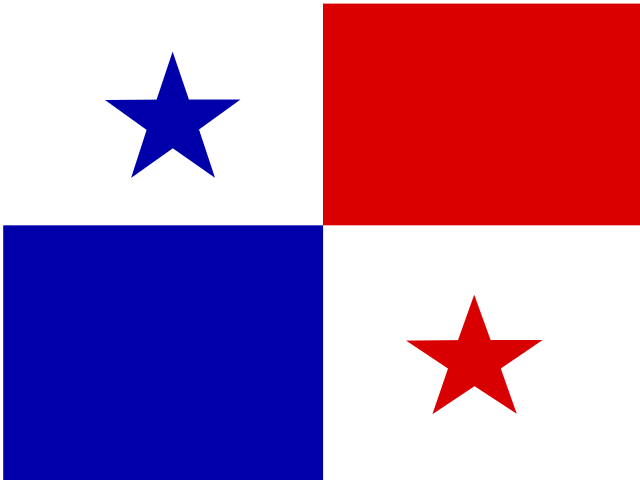 Panamá
 Venezuela
 Argentina
 Colombia
 República Dominicana
 Honduras
 España
 México