Clase alta refers to wealthy individuals with significant riches who use refined language and have a talent for sophisticated things, also characterized as well-educated or polite people.
A popular nickname for Diego Maradona, used to praise someone who performs an incredible or genius play in soccer. It originated from the emotional radio narration of Maradona's most famous goal in the 1986 World Cup. (The phrase literally means cosmic kite, which commentator Victor Hugo Morales famously called Maradona while asking what planet he came from).
Nice one, barrilete cósmico! What planet did you come from?
An expression used to signal having reached a breaking point or being fed up with a situation, or to announce the end of a session, meeting, or workday. (It relates to the idiom Hasta aquí nos trajo el río, which suggests that a journey or the current has come to an end.)
Hasta aquí llegamos, I cannot take it anymore. Well, hasta aquí llegamos, see you tomorrow.
A Venezuelan proverb used to advocate for moderation and balance. It suggests that things should not be taken to extremes, meaning one should neither underdo nor overdo something (Literally: neither so bald nor with two wigs).
Okay, just relax, ni tan calvo ni con dos pelucas. / Don't overthink or get crazy ideas, look, ni tan calvo ni con dos pelucas.
An expression used to indicate that a person with a strong character must prove their worth by winning more than once. To be considered a true leader or a tough individual, one victory is not enough: you must repeat the feat to show it was not a fluke. (In the Venezuelan plains, this draws from cockfighting and macho culture where a champion must consistently prove his dominance).
Don't be a dork, gallo que no repite no es gallo. Go out there and win, gallo que no repite no es gallo.
An expression used to warn someone to stay alert. It implies that since a warning was given, any resulting trouble is the person's own fault for being negligent. (Equivalent to the English proverb: forewarned is forearmed).
Well, you were not paying attention, and guerra avisada no mata soldado/ y si lo mata es por descuidado
Used to express that everyone has their own way of thinking, personal fixations, or opinions, and it is best to just let them be. It is equivalent to the English phrase to each their own.
I am not going to give my opinion, cada loco con su tema. I do not know what to tell you, cada loco con su tema.
An expression used when sharing gossip or a secret to indicate that the speaker will tell the story but will not reveal the identity of the person involved.
I would tell you who it is, but se dice el pecado pero no el pecador. / You will be left wondering because se dice el pecado pero no el pecador.
This phrase describes people who are all talk and no action, implying there is a lot of noise but little substance. (Cultural note: bulla means noise or racket, and cabulla is a thin rope).
Don't listen to them, Más es la bulla que la cabulla. Don't believe them, they make Más es la bulla que la cabulla.
A phrase used to signal a final limit or a departure. It is used to announce one is leaving or to warn someone that they have reached the end of the line and can go no further.
Well, I am off, hasta aquí me trajo el río. Enough, man, hasta aquí te trajo el río.
A rastrojo is an abandoned farm plot, and a batata is a sweet potato. This proverb implies that even if a romantic relationship ended long ago, the spark could be rekindled because something of value might still remain. (In Venezuela, a conuco is a small subsistence farm, and once it is left fallow, it is called a rastrojo).
En rastrojo viejo siempre hay batatas, girls. Never say never, look: en rastrojo viejo siempre hay batatas.
This proverb means that the wisdom gained from life experience is more valuable than just being clever or cunning. It is used to emphasize that an older person's advice is worth following because they have lived through many situations.
Listen to what I am telling you, because mas sabe el diablo por viejo que por diablo. Listen to what grandma says, remember that mas sabe el diablo por viejo que por diablo.
This proverb means a person's nature or character is permanent and impossible to change, similar to saying a leopard cannot change its spots. It implies that if someone is born with a certain character, no amount of correction or discipline will fix it. The word barrigon is sometimes replaced with maruton, which refers to the navel. (The literal imagery refers to the practice of wrapping a baby's abdomen in a sash to shape the body or prevent a protruding navel).
That kid is never going to change, el que nace barrigon, ni que lo fajen chiquito. And the mom thinks he is an angel and it is just a phase, but el que nace barrigon ni que lo fajen chiquito.
A phrase used to describe how people who are completely different are often attracted to each other because their personalities or backgrounds complement one another.
'Watch what you say, remember that los polos opuestos se atraen.' 'Stop with the nonsense, I do not believe in that idea that los polos opuestos se atraen.'
Something top-tier or the best thing to ever exist: a person with incredible swagger who invents their own slang words. (Dominicans are known for their unique and highly creative street slang).
A term used as an intensifier in comparisons to describe a current situation or state, most commonly used to emphasize being completely broke or badly scraped up (Fracatán is a brand of matches in the Dominican Republic).
1. damn, I am so broke that I am more broke than a Fracatán 2. man, I fell off the bike and I am more scraped up than a Fracatán


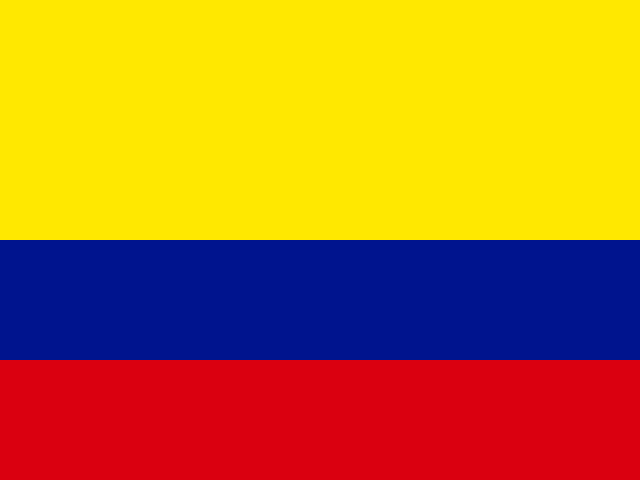 Colombia
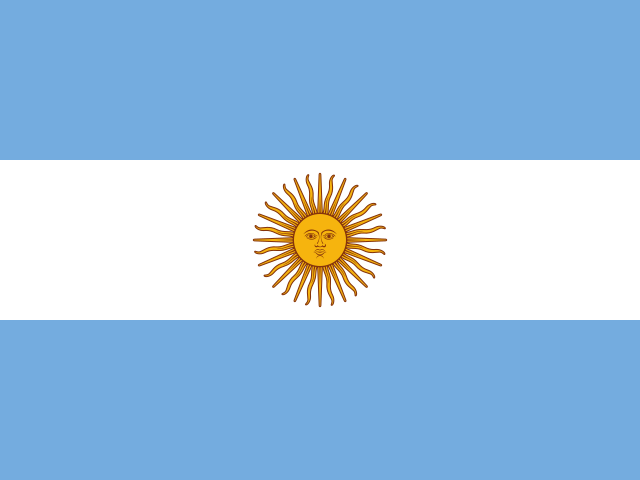 Argentina
 Venezuela
 República Dominicana