A political strategy used to distract public opinion or media attention by manufacturing or exaggerating a crisis. (These tactics often involve fear-mongering to draw attention away from government failures or social protests.)
They use the media to run Campañas de terror about zika to divert attention from what is happening in the zocalo and the thousands of protesters against Peña. (The zocalo is the main square in Mexico City; Peña refers to former president Enrique Peña Nieto.)
A Jewish political movement advocating for an independent state in Israel, often used by conspiracy theorists to promote anti-Semitic rhetoric and false flag propaganda based on false documentation.
Sionismo is to blame for the problems in the United States (example of a conspiracy follower).
A political term for manufacturing a fake trend or narrative based on a lie that eventually becomes accepted as fact, a tactic attributed to both mainstream and alternative media.
Claiming Clinton will win the presidency just because of the polls, or that 9/11 was an inside job, is just a Falsa bandera.
A phrase taken from the famous song 'Patria' by Rubén Blades. Panamanians use it to highlight the country's virtues or, ironically, to comment on political scandals and social problems (Rubén Blades is a legendary Panamanian musician and this song is considered an unofficial national anthem).
A: 'Did you hear they are investigative the Minister of Government for ties to drug trafficking?' B: 'Patria son tantas cosas bellas...'
An expression referring to any action meant to contribute to the nation's progress, from being a hardworking student to helping an elderly person cross the street.
A: Hey, Tavo, why did you give that old lady the bread if she did not pay the full price? B: You have to hacer patria, woman. The bakery is not going to go broke over 10 cents.
A political adjective used to describe speech or rhetoric that sounds like a series of repetitive, pre-packaged slogans, typically associated with leftist organizations. It suggests the person is just reciting propaganda rather than having a real conversation.
You guys always repeat the same things. You are all panfletario.
A door-to-door campaigning tactic where politicians ring doorbells to chat with residents about neighborhood issues. These visits are often criticized as being staged or scripted to ensure the politician only meets with supporters and avoids awkward confrontations (the term comes from timbre, meaning doorbell).
The Cambiemos candidates do timbreo on a regular basis.
In political slang, a derogatory term for a leftist newspaper or newsletter. It labels the publication as a biased, low quality propaganda rag. (Prensa Obrera is a well known Trotskyist newspaper in Argentina).
- Hey man, you want a copy of Prensa Obrera? - No way. Do not give me that panfleto.
Though it has military roots, in Argentina this refers to the campaign headquarters or the specific venue where political candidates and their supporters gather to wait for election results.
Everyone at the Cambiemos búnker was celebrating the victory of the macrismo movement. (Cambiemos was the political coalition of former president Mauricio Macri).
A derogatory portmanteau of militante (activist) and tonto (stupid) used to insult followers of Kirchnerism (a populist political movement in Argentina led by Néstor and Cristina Fernández de Kirchner).
In the political sphere, someone who is fiercely anti-Peronist and opposes nationalist or populist movements (Peronism is the dominant political movement in Argentina centered on the legacy of Juan Domingo Peron).
The media attacks us because we include the common people. They are all gorilas.
A derogatory, misogynistic term used by fierce political opponents in Argentina to refer to former president Cristina Fernandez de Kirchner (the word literally means mare).
Now the yegua is giving the welfare check to these low-lifes.
A sellout. Someone with weak convictions who betrays their principles or switches sides for personal gain or money. A turncoat. (In Argentina, it is often used for politicians switching between Peronism and the Radical party).
You are a vendido. Yesterday you were a Peronist and now you are a Radical.
In Argentine politics, especially within universities, this is a derogatory term for far-left activists, whether or not they actually adhere to the ideas of Leon Trotsky. (Public universities in Argentina have a long tradition of intense political militancy and student-led activism).
For the trotskos everything is the same, and that is how they end up playing right into the hands of the right wing.
Refers to the massive influence of Argentine TV host Marcelo Tinelli and his programs on public opinion. It describes the process of turning politics into a media spectacle or variety show, prioritizing entertainment over serious debate (Marcelo Tinelli is a powerful media mogul whose shows have historically used humor and satire to shape political perceptions).
Tinellización had a lot to do with the downfall of former president Fernando De la Rúa.
A supporter or member of Kirchnerism. The term was originally a nickname for former president Nestor Kirchner because he was from the far south of Argentina where penguins live, and it is now used to describe his followers. (Kirchnerism is a major political movement in Argentina led by Nestor and Cristina Kirchner).
Forget it, don't talk to him, he's a K. He's a pinguino.
A person who follows the political ideas and doctrine of Juan Domingo Peron (a three-time president of Argentina whose populist movement, focused on labor rights and social justice, is a cornerstone of the country's politics).
Argentina is divided between peronistas and radicals.
A derogatory term for supporters of the Radical Civic Union (UCR), a traditional centrist political party in Argentina. (The name is a play on the party name and the word for chicory, and the example alludes to UCR presidents historically resigning before their terms ended).
These radichetas never finish their terms in office.
A derogatory term, also known by the portmanteau caceroludo (combining the words for pot and jerk), used to mock wealthy or well-off people who protest government policies by banging pots and pans. It was specifically used against those who opposed the populist measures of the Kirchnerist administration (a cacerolazo is a common Argentine protest where people bang kitchenware).
Hey, cacerolo, you go out to protest because you cannot buy dollars, but you stayed quiet when they ran up the national debt!
A derogatory term for Peronist or Kirchnerist activists, based on the stereotype that they are only motivated by government welfare, subsidies, or handouts (the term blends choripan, a sausage sandwich common at political rallies, and plan, referring to social welfare programs).
- Those K are all choriplaneros. You should chase them off with a shovel.
A derogatory term for supporters of former Argentine president Mauricio Macri. It is a portmanteau of globo (balloon) and boludo (idiot), referencing the balloons used at rallies for his political parties (PRO and Cambiemos are center-right coalitions in Argentina).
These globoludos believe everything that donkey says!
1. A bus driver's assistant who handles fares and alerts the driver to stops (typically seen on Panama's traditional buses). 2. A person with influence or pull who uses their position to grant a favor or help someone out.
1. Tell the palanca to tell the driver to drop us off at the next stop. 2. Buddy, I need a palanca in the Ministry to help me get a job.
Refers to a person strategically placed in a job or position by a figure of power. (Often refers to political pawns or cronies installed to serve someone else's interests).
That guy is a ficha for the party. Everyone here knows the government is full of fichas.
A person who gets a government job through political favors or patronage, typically collecting a salary without actually working. (In Panama, this refers to ghost employees placed on the public payroll as a reward for political support).
'Everyone knows that woman is a government Botella' ; 'The minister fired a lot of people just to hire his own Botellas.'
In Argentina, to switch political sides, defect, or become a turncoat. (The term was coined in 2005 after Dr. Eduardo Borocotó was elected to Congress for one party but immediately flipped to support the opposing government). It is now a common verb used to describe political flip-flopping.
Congressman X borocoteó by leaving his party and switching sides.
The science and magic of robbery, where you enter with two menthol candies (Halls) in your pocket and a year later you leave with millions obtained 'mysteriously.'
- My child, what do you want to be when you grow up? - A mugger on a motorcycle, mommy. - No son, be a político, it is the same thing but without the motorcycle.
A derogatory backronym for the Modern Revolutionary Party (PRM), defining them as a gang of shitty troublemakers. (The PRM is a major political party in the Dominican Republic).
If we lose the elections, we will throw people into the streets against them.
A pejorative used by self-described patriots to label anyone who disagrees with their right-wing views, specifically targeting those who do not attend Sunday mass. (In Spain, this term is often weaponized by the far-right against secular or progressive individuals).
Damn comunista, I bet you are a terrorist too! (after a criticism of the church)
The practice of hand-picking someone for a position or responsibility based on personal whim, bypassing any democratic or fair selection process. (The word is a play on 'dedo', finger, and 'democracia', democracy).
I am President Martinelli, using dedocracia is my privilege, so what! (Ricardo Martinelli served as president of Panama from 2009 to 2014).
To skim some extra cash or collect kickbacks, usually through corrupt practices in a public or private institution. (The term comes from the word for crumb, implying picking up small pieces of illicit profit).
I promise that if I win the elections, I will let everyone in my party boronear!
A government shill or a public employee who backs the ruling party just because they are on the state payroll. In highly partisan contexts, it is also used as an insult for anyone who stays neutral rather than criticizing the authorities. (In the Dominican Republic, the term literally translates to check-eater, implying their loyalty is bought with government money).
Look at that comecheques, he is going to work instead of joining the protest.
In Dominican urban slang, demagogia or the shortened dema refers to envy or being a hater. It also describes the act of sweet-talking or selling people a pipe dream to win their support, a tactic used by both politicians and street artists.
'I am going to plant cassava in the 27th of February tunnel' (a major expressway tunnel in Santo Domingo) : Hipolito Mejia. 'I am going to provide for all the single mothers' : Danilo Medina. (Both quotes are attributed to former Dominican presidents).
An autonomous community located in Spai... TO HELL WITH THAT! LONG LIVE, LONG LIVE, LONG LIVE, LONG LIVE THE FREE LAND! (The entry starts as a formal Spanish definition but breaks into Catalan separatist slogans; Terra Lliure was a pro-independence movement).
Catalunya is the region that contributes the most economically to Spain, and it deserves economic independence at the very least.
A state of systemic corruption where everyone is snatching whatever they can. Since everyone is involved in the looting, nobody has the moral authority to point fingers at others. It is similar to a chaotic free-for-all (the term comes from the verb coger, meaning to grab or take).
A comedy troupe led by Rene Fiallo in the 1980s, including performers like Juan Carlos Pichardo and Angel Muñiz. They were famous for political song parodies and character sketches such as Los Gangsters, and they starred in the TV shows Tele Relajo and Tele Loquera (this collective is considered a landmark era in Dominican television comedy).
That is why now, I will never drink again, I will never drink again, I will never drink again.
In the Dominican Republic, La Ñoña is a slang term for the presidential sash. When a president is inaugurated, people say he put on the ñoña, referring to the way the sash is worn diagonally across the chest.
This will finally be fixed the day Bacho puts on the ñoña.
A boogeyman or a scary figure used to threaten someone into behaving. (The term was popularized by former Dominican president Hipolito Mejia as a figurative threat against his political rivals, the PLD party).
Eat your pigeon peas or I will let the Perro de Mamá Belica loose on you.
A backhoe or excavator. This nickname originated in the late 1990s during the construction of major tunnels in Santo Domingo under the PLD party government. Party members were nicknamed 'comesolos' (literally 'those who eat alone', referring to a reputation for keeping government perks to themselves), and the name was eventually applied to the heavy machinery used in their signature infrastructure projects.
They are using two comesolas to build the tunnel on Nunez Avenue.
A weekly political humor magazine (and later general humor) published in the mid-1990s by Huchi Lora and Freddy Beras Goico. It featured satirical poems, caricatures, and parody ads, as well as recurring humor columns. It was a major platform for many of the most famous Dominican comedians and cartoonists of the era. (Freddy Beras Goico and Huchi Lora are legendary figures in Dominican media).


 Estados Unidos
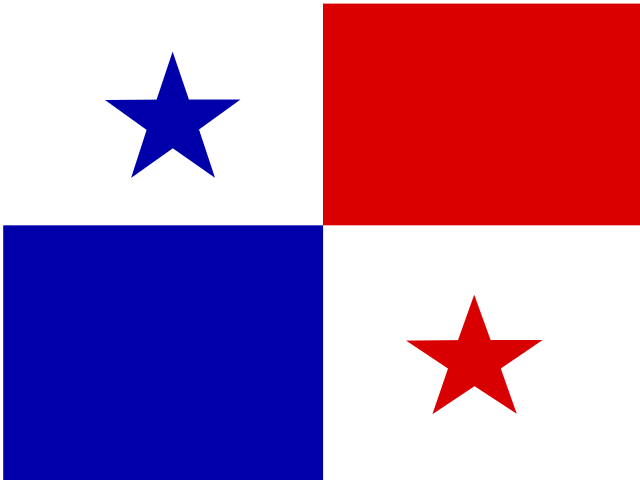 Panamá
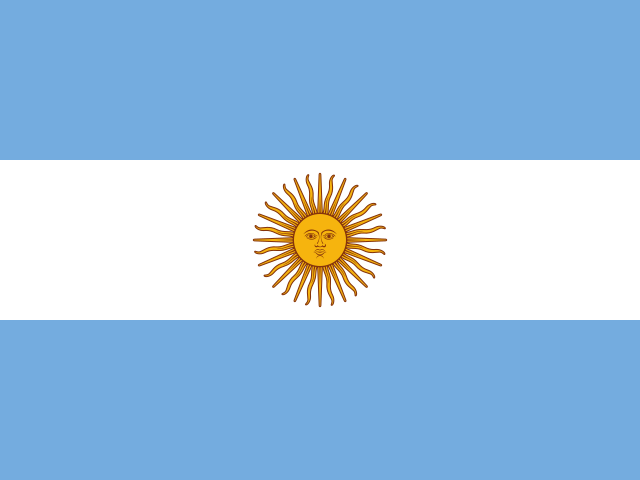 Argentina
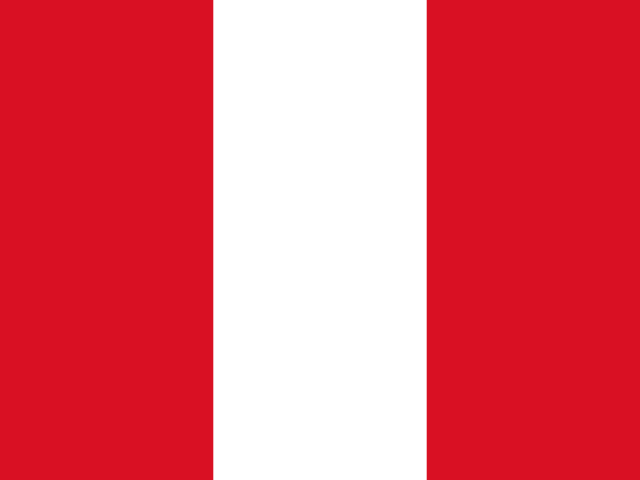 Perú
Perú Venezuela
 República Dominicana
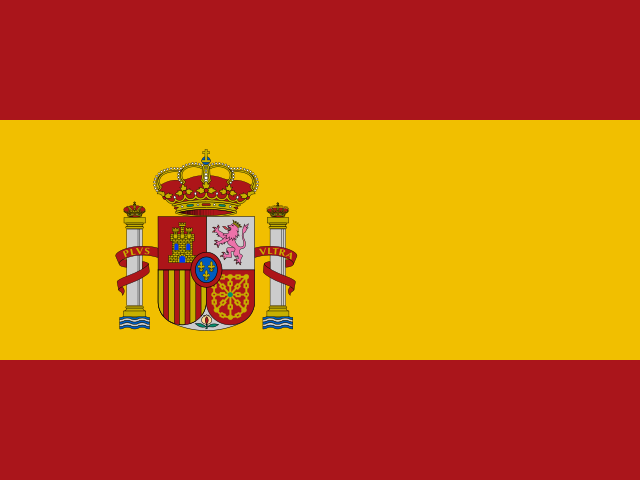 España