An altar or ritual table used to present offerings to Pachamama, or Mother Earth, in Andean religious traditions. (These rituals are a central part of indigenous Bolivian culture used to ask for prosperity or give thanks).
We have to set up an APXATA so that things go well for us all year long.
iniquidad refers to wickedness, godlessness, or guilt that is considered more serious than a standard sin. It is any act that goes against morality, justice, and religion (in Colombia, this term often carries a heavy religious weight, implying deep moral corruption).
we can recognize the iniquidad, the crooked path or the deviation from the right path, despite its gravity.
A Catholic title for the Virgin Mary originating in Mexico, whose main shrine is at Tepeyac Hill in Mexico City. She is a central symbol of the 'bronze race' (a term for the mixed-race or indigenous people of the Americas), a banner of freedom, and the supreme commander of the poor.
Traditional characters from the Corpus Christi festival. They are performers dressed as devils in masks and red and black striped costumes who dance and lead the processions. (These figures are a staple of Panamanian folklore, specifically the Diablicos Sucios, representing a blend of religious and indigenous traditions).
A: Better not take the kid to that parade because he is really scared of the diablicos. B: Take him, woman. He needs to learn those are just normal people who are not going to do anything to him.
An expression used when bad luck or an unexpected setback ruins a moment of peace or prosperity. It suggests that a malicious twist of fate spoiled a good situation.
We were having a beautiful vacation, but el diablo metió la cola, I twisted my ankle and we had to come back.
A religious tradition from the Venezuelan Andes where the figurine of the baby Jesus is literally stood up in the Nativity scene. Participants pray the rosary and sing carols accompanied by a violin and a cuatro (a small four-stringed guitar from Venezuela). During the ceremony, two godparents are chosen to carry the image in a procession through the house and surrounding area.
An exclamation of shock, disbelief, or concern used mostly by older people and those from rural provinces to react to something inconceivable or startling. (The term refers to Jesus of Nazareth, a central figure in Panamanian folk religion).
'You already have a boyfriend even though you are so young? ¡Nazareno!' | 'Oh, ¡Nazareno! What happened to you?'
A religión is a doctrine made up of a set of principles, beliefs, and practices regarding existential, moral, and supernatural questions, usually based on sacred texts, which unite followers in a shared moral community.
In the Canary Islands, Spain, a separate section within a Catholic cemetery used for burying people of other religions or those who were not baptized (this term stems from the English word churchyard).
A person of the Muslim religion died and for that reason was buried in the chercha of the graveyard.
An organized group of believers who, through baptism and confirmation, have taken the name of Jesus Christ upon themselves. To be the true Church, it must be the Lord's, having his authority, teachings, laws, and ordinances, and be governed by Him through chosen representatives (this terminology is specific to the theology of The Church of Jesus Christ of Latter-day Saints).
The Lord added daily to the Iglesia de Jesucristo, Acts 2:47. We, being many, are one body in Christ, Rom. 12:5. By one Spirit we were all baptized into one body, 1 Cor. 12:13. The Iglesia de Jesucristo is built on the foundation of the apostles and prophets, Eph. 2:19,20. Apostles and prophets are essential to the Iglesia de Jesucristo, Eph. 4:11,16. Christ is the head of the Iglesia de Jesucristo, Eph. 5:23.
A breakaway group from The Church of Jesus Christ of Latter-day Saints based in Independence, Missouri, with roughly 250,000 members. Following Joseph Smith's death in 1844, a period of disorganization occurred regarding the church presidency (pride was clearly on display) as various groups followed different leaders, the largest being the followers of Brigham Young. In 1860, a conference in Amboy, Illinois, held by people who lacked any authority, reorganized the church with Joseph Smith III as president. This group was known as the Reorganized Church of Jesus Christ of Latter Day Saints until 2001.
A religious organization in the Latter Day Saint movement, founded by Joseph Smith III in Amboy, Illinois, on April 6, 1860. They split from The Church of Jesus Christ of Latter-day Saints due to disagreements regarding Brigham Young's succession to the presidency. As of 2001, the group is known as the Community of Christ.
The Iglesia Reorganizada de Jesucristo de los Santos de los Ultimos Dias.
A religious movement founded on April 6, 1830, in Palmyra, New York, by Joseph Smith. Followers profess to follow the teachings of Jesus Christ but do not consider themselves part of Catholic, Orthodox, or Protestant traditions, viewing their faith as a restoration of early Christianity. They are commonly known as Mormons because they include the Book of Mormon in their canon of holy scriptures.
La Iglesia de Jesucristo de los Santos de los Ultimos Dias.
A volume of scripture used by The Church of Jesus Christ of Latter-day Saints, consisting of an abridgment of records from ancient inhabitants of the Americas. Compiled by the prophet Mormon and translated by Joseph Smith, it recounts the history of groups who migrated from the Old World and the visit of Jesus Christ to them after his resurrection. Smith described the Libro de Mormon as the keystone of the religion, teaching that its precepts bring followers closer to God.
Joseph is a fruitful bough, Gen. 49:22. Truth shall spring out of the earth, Ps. 85:11. The Libro de Mormon and the Bible shall grow together, 2 Ne. 3:12. The Lord covenanted with Enos to bring the Libro de Mormon to the Lamanites, Enos 1:15.
A faithful member of the Church of Jesus Christ (the formal term for a member of the Mormon faith).
Gather my Santo de los Ultimos Dias unto me, Ps. 50:5. Saul ravaged the Santo de los Ultimos Dias in Jerusalem, Acts 9:1, 21. Peter also came to the Santo de los Ultimos Dias who lived in Lydda, Acts 9:32. To all those in Rome, called to be Santo de los Ultimos Dias: Grace and peace, Rom. 1:7. You are fellow citizens with the Santo de los Ultimos Dias, Eph. 2:19, 21.
A fanatic or cultist, referring to someone who is stubbornly and rigidly devoted to a religious group or a specific subculture. (In Peru, this term is used broadly to describe anyone who is extremely uncompromising about their beliefs or niche interests).
Evangelicals, Mormons, Witnesses, satanic cults, metalheads, etc. (all considered a Cectario).


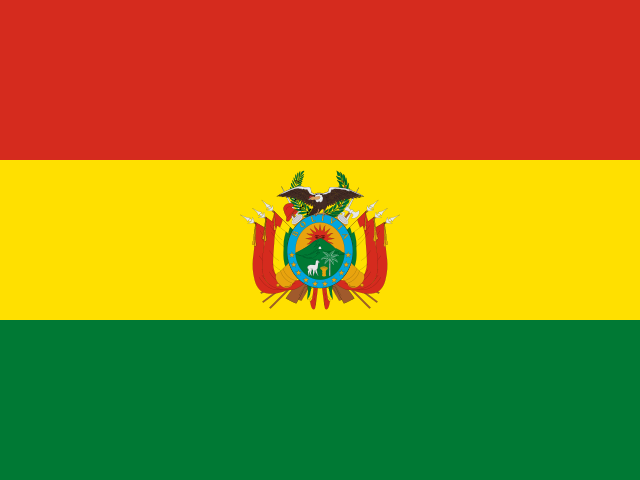 Bolivia
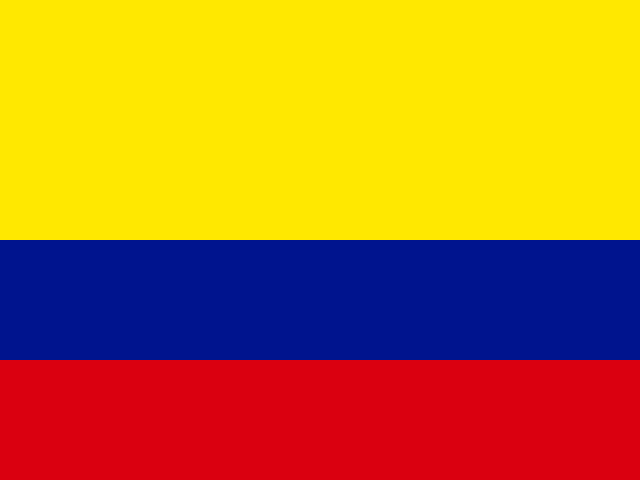 Colombia
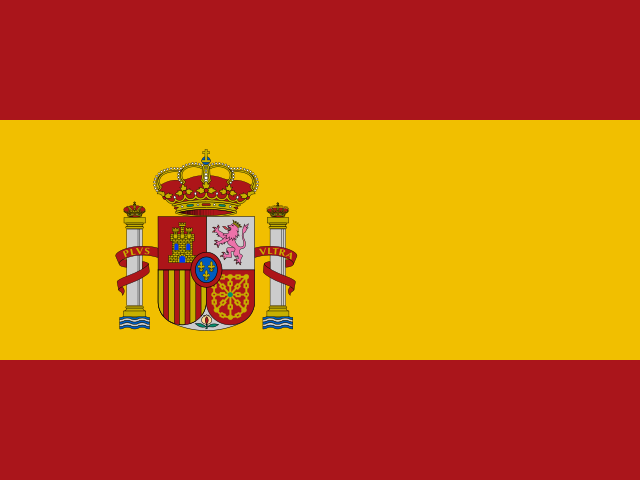 España
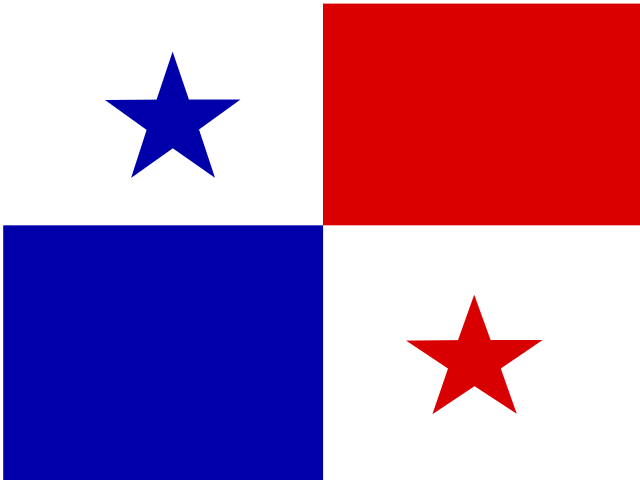 Panamá
 Argentina
 Venezuela
 República Dominicana
 Estados Unidos
 Perú
Perú