A person from Los Mina (a working-class neighborhood in Santo Domingo Este). While the term can simply denote someone born and raised there, it is often used as a derogatory label for a thug, hoodlum, or scammer due to the area's rough reputation.
an Andean civilization that flourished in the central Andes from approximately the 7th to the 13th century AD, extending north to the modern-day Peruvian department of Lambayeque.
Wari, famous for its metallurgy and the Staff God.
Ornate, handmade hair ornaments worn by women as part of the Panamanian national costume, the pollera. These beaded pieces are designed to shiver or shake as the wearer moves (the pollera is Panama's traditional, intricately embroidered dress).
A: The girl left her tembleques at home. B: Oh, the teacher is not going to let her dance like that.
Traditional characters from the Corpus Christi festival. They are performers dressed as devils in masks and red and black striped costumes who dance and lead the processions. (These figures are a staple of Panamanian folklore, specifically the Diablicos Sucios, representing a blend of religious and indigenous traditions).
A: Better not take the kid to that parade because he is really scared of the diablicos. B: Take him, woman. He needs to learn those are just normal people who are not going to do anything to him.
A Panamanian slang term for traditional folk dance music, typically featuring accordions and percussion (often referred to locally as 'musica tipica').
A: At Ana's birthday they only played Pindin. And there I was, not knowing how to dance, girl... B: Oh, definitely, it is a shame not knowing how to dance.
A piece of traditional folk jewelry consisting of a gold necklace with flat, scale-like links that feature decorative patterns or small holes. (This necklace is an essential part of the jewelry worn with the pollera, Panama's national dress).
A: 'I want to get a cadena chata for my grandma.' B: 'Oh, definitely, she loves traditional folk items so much.'
A homemade herbal liqueur from the Venezuelan Andes, traditionally consumed to stay warm while traveling through the high-altitude moorlands known as the paramo. It is called calentaito because it warms the body up in the middle of such intense cold. (The paramo is a cold, high-altitude ecosystem found in the northern Andes).
Son, come here and let's have a calentaito now that the cold has arrived. / This calentaito is the best thing for the cold so I don't get altitude sickness.
A very common sweet treat made from the squash of the same name. It can be prepared in various ways and is common in the Andean region (in Venezuela, this refers to the mountainous states in the west).
Sweetie, come and try this delicious zapallo treat. / Today we will make zapallo preserve to eat with crackers.
A percussion instrument used in Panama's national folk music known as típico (a popular accordion-led genre). It is a long, grooved tube that is scraped with a wire comb. It is also a staple of vallenato music.
"I left the guacharaca behind, Joselin. Now what do we do?" | "My son plays the guacharaca in the group Los Siete."
A popular street food made of deep-fried pork rinds or pork skin. (In Panama, it is a common snack known for its crunchy texture and high fat content.)
"She loves chicharrón, that is why she is that fat" | "They do not let my dad eat chicharrón because his cholesterol is very high"
A traditional sweet spread sold by street vendors, especially common in the rural interior of the country. It is made from milk, cornstarch, and sugar, resulting in a thick, jam-like consistency. (In Panama, the interior refers to the provinces and rural areas outside of the capital city.)
Dad, can you buy me a manjar? | Bread tastes delicious with a little manjar on top.
A traditional textile handmade by the Guna indigenous group, formerly known as Kuna. These fabrics feature colorful motifs inspired by nature, like toucans and turtles (they are created using a complex reverse-appliqué technique and are a core part of traditional women's clothing).
"We bought that mola when we went to Panama" : "Molas are very expensive because they make them by hand"
A rural town in the state of Barinas, Venezuela, where locals maintain traditional ways of life like hunting monkeys and iguanas for food. It is known for lacking basic services like running water and electricity. (Barinas is a western plains state known for its rugged, traditional culture).
1. A sucker or a pushover, someone who is easily exploited or fooled by others. 2. A traditional Afro-Panamanian dance and musical style from the Caribbean coast (this genre celebrates the culture and history of rebellion of the Cimarrones, or enslaved Africans who escaped colonial rule).
"Don't lend that guy any more money, he's playing you for a Congo!" : "Every year they host a Congo dance festival on the coast."
A singer who performs improvised rhyming verses, usually in the form of décimas, during a cantadera (a traditional Panamanian folk music gathering where performers compete).
Julia's boyfriend is the best trovador in town; To be a trovador you have to know a lot about poetry.
A folk tradition involving a gathering of people, usually from the country's rural interior, who take turns performing improvised verses. It typically takes place in a competitive atmosphere where each singer responds to the others with challenging lyrics (this refers to the Panamanian tradition of improvised poetic duels known as décimas).
In December a cantadera is always organized in the village or When my grandfather was young he used to participate in cantaderas
A traditional corn dough roll that is sometimes mixed with chicken or coconut. It is shaped into a cylinder and boiled while wrapped in corn husks (a common staple in Panamanian cuisine often eaten at breakfast).
I ate two bollos for breakfast | My grandma makes delicious corn and coconut bollos
A fast-paced, catchy genre of folk music and dance from the Venezuelan Andes. It is characterized by a style where partners hold hands and move their arms vigorously up and down (it is traditional party music from the mountain regions of Mérida, Táchira, and Trujillo).
It is time for some great Raspa Canilla. / Look at those two, dancing Raspa Canilla.
A smart person or someone who knows a lot. Depending on the tone, it can be used as a term of endearment for a bright child or as a way to call someone a know-it-all.
You really are a sabiondo, son, I am proud of you. / Stop being such a sabiondo, you sound arrogant.
A figure from Panamanian folklore, a female spirit who wanders through forests and mountains seducing men to drain their life. Legend says she emits a high-pitched sound that is misleading: if it sounds distant, she is actually close by, and if it sounds close, she is far away. (She is typically described as a ghostly, white, sheet-like figure).
"Don't talk to the little girl about the Silampa, or she won't be able to sleep" : "I was going to tell him the story of the Silampa, but he didn't know it"
A traditional Panamanian dish made from corn dough filled with pork or chicken, wrapped in a leaf (specifically a bijao leaf, locally called a tallo leaf), and boiled.
How many tamales do we need to make for the girl's birthday? / They sell delicious tamales at that restaurant.
A traditional folk music genre performed to the rhythm of drums, guitar, and singing. It is a signature sound of the Panamanian countryside, specifically the central provinces.
There is going to be a Tamborito this Saturday to celebrate Esteban's birthday. During Carnival we always get a Tamborito going every night in the backyard.
Homemade moonshine or liquor made from fermented corn or sugarcane. It is primarily consumed in the countryside (in Panama, the interior refers to rural provinces outside the capital city).
There is nothing better to go with your meals than a nice cold chirrisco | Sir, how much are you selling the chirrisco for?
A term referring to the rural provinces of the country's interior, characterized by their strong folkloric traditions. People from these areas are distinguished by a specific country accent known as jalao. (This expression usually points to the central provinces, the cultural heartland of Panama).
That woman talks like she is from Allá 'onde uno : We are going on vacation to Allá 'onde uno.
A proverb meaning that raising livestock provides enough to live on so that one does not need to engage in other types of hard labor, such as farming the land.
I want you to know that: 'La crianza aleja la labranza'.
A ceremonial song and dance performed by the indigenous Taíno people (the pre-colonial inhabitants of the island) which is a foundational element of Dominican cultural heritage.
Erredé comes from the phonetic pronunciation of the initials RD (República Dominicana). It is used to describe the trashiest and most uncivilized side of Dominican society, characterized by ignorance, vulgarity, and a total disregard for laws or social etiquette.
Erredé is a woman giving beer to her small children and posting it on social media. Erredé is an idiot throwing a foam cup on the ground right next to an empty trash can. Erredé is two unkempt guys popping wheelies on a motorcycle with the lights off, going the wrong way on San Vicente (a major avenue in Santo Domingo).
indigenismo is a cultural, political, and anthropological movement focused on the study and appreciation of indigenous cultures, while challenging the discrimination and ethnocentrism faced by native peoples.
An indigenous person was passing through my city. indigenismo is a cultural movement.
Something done purely on a whim, following one's own will and desires while ignoring any objections. The term is a contraction of the phrase 'me da la gana' (because I feel like it) and was coined by Dominican writer Jacinto Gimbernard in the 1920s.
I do not use the transit union buses because of that medalaganaria way they drive, like they just do whatever they want.
Originally used by urban music artists to mean authentic and honest, this term became a widespread social media trend. Due to its overuse, it now often carries a tone of irony or pretense, usually describing someone who is trying too hard to seem genuine (urban music in the Dominican Republic, such as dembow, heavily influences local slang).
A term for a dark-skinned person who defies racial prejudices by being cosmopolitan, well-educated, or wealthy. (In the Dominican Republic, it suggests the person has distanced themselves from the street-culture stereotypes often projected onto their race. Vizcaya is a traditional upscale restaurant in Santo Domingo).
She is happy with her moreno lavaíto, he takes her to Vizcaya and does not wear caps or chains.
Used to describe a person, object, or idea that has fully integrated into or adapted to the Dominican culture and way of life. (The term comes from platano, the plantain, which is a staple food and cultural icon in the country).
The opposite of the complejo de Guacanagarix, referring to a blind chauvinism where one believes everything in the Dominican Republic is superior, rejecting any social self-criticism. (Named after Caonabo, a Taino chief who resisted the Spanish, symbolizing fierce local pride.)
we ain't got no education but we'll pump three slugs into you hahahaha you scrub prrrrra
Something that existed in the Dominican Republic a long time ago but was killed off by the local rejection of reading and the instant culture of the internet. Today, spelling mistakes are found daily in newspapers, billboards, and on TV, thanks to the law of least effort. Worst of all, many feel proud of it because it supposedly identifies them more with the common people, as if being educated was only for the rich.
dont judge my Ortografía cuz u can understand it anyway u fool, im out, PRRRA
An old name, still in use today, for bachata music, referring to its lyrics about romance and heartbreak. (Bachata is a genre of guitar based music from the Dominican Republic once associated with the rural poor and drinking to forget a broken heart.)
Trúcamelo is the Dominican name for hopscotch, a playground game where you toss a stone and jump through a series of numbered squares (this term is specific to the Dominican Republic).
- I am going to teach you how to play trúcamelo, I used to play it when I was a kid. - But do they not have it on PlayStation?
A slang term Dominicans use for classical music because it is not danceable. It is most commonly heard on the radio during Holy Week (a religious period when stations traditionally replace upbeat genres like merengue with somber music).
- Hey, that is Vivaldi. - Turn off that música de muertos and put on Monkey Black, that is real culture.
The solemn oath taken by the founders of the Dominican Republic, the secret society La Trinitaria, to achieve independence from Haiti. It defines the national flag, the motto God, Homeland, and Liberty, and pledges life and property to the cause of a free nation. (This is the country's founding pledge, written by national hero Juan Pablo Duarte).
-- Hey student, recite the Juramento Trinitario. -- Get off my back.
To a Dominican, Nueva York refers to the entire United States, and sometimes any foreign country (due to the large Dominican population in New York City, it became the primary reference point for all emigration to the U.S.).
-- So-and-so left for Nueva York. -- No, he went to Miami. -- But that is Nueva York too.
Annual event held at the Plaza de la Cultura Juan Pablo Duarte (a cultural complex in Santo Domingo) that is supposedly for selling books, but in reality, it is mostly a place to buy pizza, cheap plastic bead necklaces, and puzzle books featuring the bachata band Aventura.
-Let's go buy a Cartel de los Sapos (a popular drug-trafficker TV series) puzzle at the Feria del Libro. -Oh no, girl, I would rather have one of Sobeida (a woman notorious for her role in a local drug trafficking scandal) in a bikini.
These faceless dolls are the most famous traditional craft of the Dominican Republic. They lack facial features to represent the diverse heritage of the Dominican people, who are a blend of indigenous Taino, Spanish, and African roots. This racial mixing means there is no single face that identifies all Dominicans. (The most famous ones are produced in El Higuerito, Moca).
An art center and grill bar in the Espaillat province. It was the first pay-what-you-want venue in the Dominican Republic, where customers paid what they felt the service was worth. It is named for its construction style, which mimics indigenous stilt houses (Moca is the capital city of the Espaillat province).
A redundancy where two or more words are used in the same sentence that are unnecessary to convey the meaning because the sense is already implied. (In the Dominican Republic, these redundant pairings are a very common and accepted feature of colloquial speech).
1) Lo vi con mis propios ojos, and I did not believe it! 2) Girl! Sube para arriba to study and then baja para abajo so you can eat dinner. 3) Metete adentro that house! and then sal pa fuera because I do not want you in there for long!


 República Dominicana
 Global
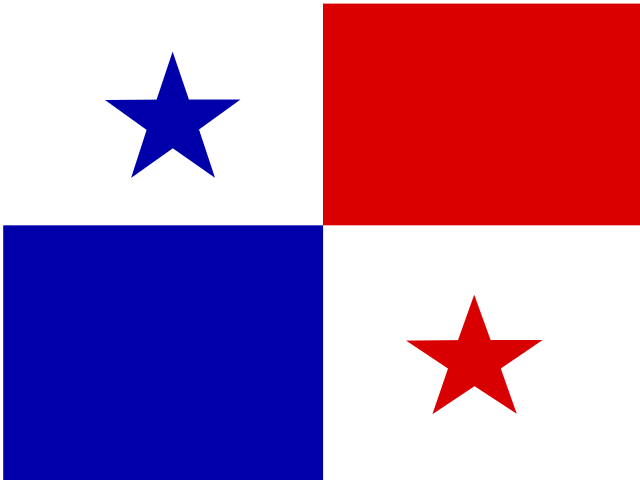 Panamá
 Venezuela