Ornate, handmade hair ornaments worn by women as part of the Panamanian national costume, the pollera. These beaded pieces are designed to shiver or shake as the wearer moves (the pollera is Panama's traditional, intricately embroidered dress).
A: The girl left her tembleques at home. B: Oh, the teacher is not going to let her dance like that.
Traditional characters from the Corpus Christi festival. They are performers dressed as devils in masks and red and black striped costumes who dance and lead the processions. (These figures are a staple of Panamanian folklore, specifically the Diablicos Sucios, representing a blend of religious and indigenous traditions).
A: Better not take the kid to that parade because he is really scared of the diablicos. B: Take him, woman. He needs to learn those are just normal people who are not going to do anything to him.
A Panamanian slang term for traditional folk dance music, typically featuring accordions and percussion (often referred to locally as 'musica tipica').
A: At Ana's birthday they only played Pindin. And there I was, not knowing how to dance, girl... B: Oh, definitely, it is a shame not knowing how to dance.
A piece of traditional folk jewelry consisting of a gold necklace with flat, scale-like links that feature decorative patterns or small holes. (This necklace is an essential part of the jewelry worn with the pollera, Panama's national dress).
A: 'I want to get a cadena chata for my grandma.' B: 'Oh, definitely, she loves traditional folk items so much.'
A traditional, rhythmic vocalization or melodic shout used in Panamanian folk music (música típica). In rural areas, it also serves as a greeting between country people. (The Saloma is a distinctive yodel-like sound characteristic of the Panamanian countryside).
A: The boy knows how to dance típico very well, but we haven't been able to teach him to salomar yet. B: The thing is, you have to practice Saloma a lot for it to sound right, it is harder than it looks.
A percussion instrument used in Panama's national folk music known as típico (a popular accordion-led genre). It is a long, grooved tube that is scraped with a wire comb. It is also a staple of vallenato music.
"I left the guacharaca behind, Joselin. Now what do we do?" | "My son plays the guacharaca in the group Los Siete."
A popular street food made of deep-fried pork rinds or pork skin. (In Panama, it is a common snack known for its crunchy texture and high fat content.)
"She loves chicharrón, that is why she is that fat" | "They do not let my dad eat chicharrón because his cholesterol is very high"
A traditional sweet spread sold by street vendors, especially common in the rural interior of the country. It is made from milk, cornstarch, and sugar, resulting in a thick, jam-like consistency. (In Panama, the interior refers to the provinces and rural areas outside of the capital city.)
Dad, can you buy me a manjar? | Bread tastes delicious with a little manjar on top.
A traditional textile handmade by the Guna indigenous group, formerly known as Kuna. These fabrics feature colorful motifs inspired by nature, like toucans and turtles (they are created using a complex reverse-appliqué technique and are a core part of traditional women's clothing).
"We bought that mola when we went to Panama" : "Molas are very expensive because they make them by hand"
A traditional sweet snack, usually sold by street vendors. It is made from cassava starch or cornstarch, sugar, eggs, and cinnamon. These small, crunchy cookies are easily recognized by their coiled or spiral shape.
Don't eat so many suspiros, they have a lot of sugar. | My grandma makes some delicious suspiros.
A singer who performs improvised rhyming verses, usually in the form of décimas, during a cantadera (a traditional Panamanian folk music gathering where performers compete).
Julia's boyfriend is the best trovador in town; To be a trovador you have to know a lot about poetry.
A folk tradition involving a gathering of people, usually from the country's rural interior, who take turns performing improvised verses. It typically takes place in a competitive atmosphere where each singer responds to the others with challenging lyrics (this refers to the Panamanian tradition of improvised poetic duels known as décimas).
In December a cantadera is always organized in the village or When my grandfather was young he used to participate in cantaderas
A traditional Panamanian dish made from corn dough filled with pork or chicken, wrapped in a leaf (specifically a bijao leaf, locally called a tallo leaf), and boiled.
How many tamales do we need to make for the girl's birthday? / They sell delicious tamales at that restaurant.
A traditional folk music genre performed to the rhythm of drums, guitar, and singing. It is a signature sound of the Panamanian countryside, specifically the central provinces.
There is going to be a Tamborito this Saturday to celebrate Esteban's birthday. During Carnival we always get a Tamborito going every night in the backyard.
Homemade moonshine or liquor made from fermented corn or sugarcane. It is primarily consumed in the countryside (in Panama, the interior refers to rural provinces outside the capital city).
There is nothing better to go with your meals than a nice cold chirrisco | Sir, how much are you selling the chirrisco for?
A term referring to the rural provinces of the country's interior, characterized by their strong folkloric traditions. People from these areas are distinguished by a specific country accent known as jalao. (This expression usually points to the central provinces, the cultural heartland of Panama).
That woman talks like she is from Allá 'onde uno : We are going on vacation to Allá 'onde uno.
A traditional Dominican figure who brings toys and candy to children who were skipped by the Three Kings on January 6th. (This custom is likely derived from the Italian tradition of La Befana).
I wanted an iPod and the Vieja Belén left me a whistle.
The smallest segment of a tangerine. According to local tradition, this piece is offered to the Virgin of Altagracia by throwing it over the roof of a house (The Virgin of Altagracia is the patron saint of the Dominican Republic).
That guy is so cheap he even eats the Gajito de la Virgen.
A style of merengue with religious or rural themes, popularized by Elenita Santos starting in the early 1950s (a traditional folk music genre often performed at religious festivals).
A time frame ranging from thirty minutes to three hours later than the agreed-upon time (In the Dominican Republic, social events rarely start on time, and guests are expected to arrive significantly later than the official invitation says).
We were supposed to meet at 7:00, but it was Hora dominicana and I arrived at 8:45.
A handcrafted Christmas tree made of dried branches and twigs, usually painted white. It provides a bright, wintry look that serves as an alternative to the traditional green pine tree. (These are iconic artisanal decorations sold by street vendors in the Dominican Republic during the holidays).
Dry palm twigs used in rural areas to make traditional brooms (in the Dominican Republic, these are the primary material for rustic handmade sweeping tools).
A tiriguillo broom is the best for a wooden floor.
A term for the Diablo Cojuelo, the central masked devil character of Dominican carnivals. It is a shortened form of the word for a masked person. (The Diablo Cojuelo is the most iconic figure of Dominican Carnival, known for wearing elaborate horned masks and colorful costumes).
Here come the mácaro, run for it! What are we celebrating on February 27? The day of the mácaros.
It is simply the best baseball team in the Dominican Republic, envied by many and praised by others. (Licey refers to Tigres del Licey, the country's oldest and most successful professional baseball team).
Licey Champions! 100 years of glory and tradition!
One of the most successful baseball teams in the Dominican Republic. As of this writing, they have 19 national titles and 10 Caribbean Series championships. Their main rivals are the Aguilas Cibaenas and the Leones del Escogido, the latter of whom are always jerking themselves off thinking they can actually compete with the glorious Tigres del Licey. Licey is also one of the rowdiest towns in the country, a leader in strikes and the sport of stone-throwing. (Baseball, or pelota, is the national sport and Tigres del Licey is the most winning franchise).
- Where are the Tigres del Licey playing today, my guy? - That is a huge, huge hit, way back, Tulile knocked it out! Tigres del Licey takes the lead again! (Remembering the Tulilazo).


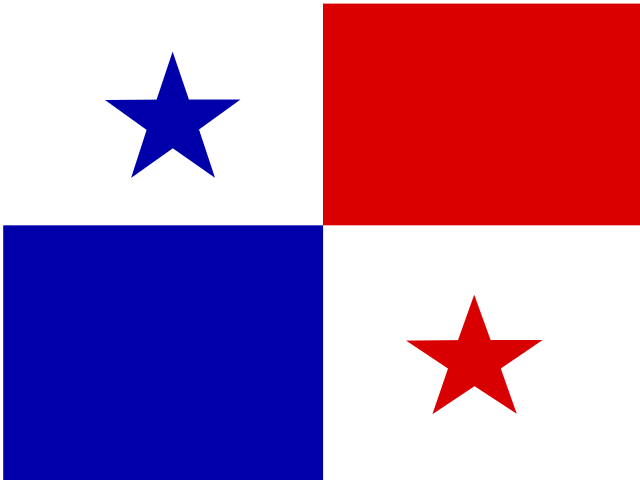 Panamá
 República Dominicana