To slack off, lounge around, or indulge in laziness (a reference to how lizards, or lagartos, spend hours lying motionless in the sun).
Carolina spent all her time lagartear and that is why she failed math.
Automatically translated from Spanish
An exclamation of surprise or amazement used in eastern Bolivia (primarily in the departments of Santa Cruz, Beni, and Pando).
Elay! Are you really getting married?
Automatically translated from Spanish
An expression used to describe when someone gets everything through sheer luck or a fluke, rather than through their own effort or merit (in Bolivia, concha refers to nerve or luck, whereas in other Spanish-speaking countries it can be a vulgarity).
Daniel's house is PURA CONCHA, he does not even work.
Automatically translated from Spanish
A nickname used to refer to the country of Argentina (derived from gaucho, the traditional cowboy figure iconic to Argentine culture).
I want to go on vacation to GAUCHILANDIA.
Automatically translated from Spanish
An expression used to say that someone is completely mistaken, way off base, or ignorant of the truth. (A tiesto is a clay pot, so the phrase suggests being far from the mark.)
That is not how things are, Maria. You are LEJOS DEL TIESTO.
Automatically translated from Spanish
To have pull or influence with people in high-ranking positions, like government officials or corporate executives, who are ready to grant you favors.
You have to TENER MUÑECA to be rich in this country!
Automatically translated from Spanish
A belt, specifically when used to whip or hit children as punishment for misbehaving (corporal punishment is a traditional disciplinary method in many Bolivian households).
I am going to hit you with the chicote if you keep misbehaving.
Automatically translated from Spanish
A slang term for a gay man, often used in a vulgar or derogatory manner.
Carlos is a trolo, that is why he does not go out with girls.
Automatically translated from Spanish
A euphemism used to say that someone is vomiting.
Manuel has started to ARROJAR.
Automatically translated from Spanish
The act of using a belt or strap like a whip to corporally punish children (A chicote is a traditional whip or lash).
Your mom is going to CHICOTEAR you if she sees you screaming like that.
Automatically translated from Spanish
A guy who is extremely thick-headed, stupid, or annoying to the point that nobody can stand him.
Manuel is a total trolazo, I do not want to invite him to the party.
Automatically translated from Spanish
Slang term for jail, prison, or a police lockup.
They are going to throw me in Cañá if I keep stealing.
Automatically translated from Spanish
To get bummed out, feel down, or get the blues, whether or not there is a specific reason.
You cannot BAJONEARSE because you lost your job, you have to look for another one.
Automatically translated from Spanish
A person with thick, large, or protruding lips.
Angela is trompuda.
Automatically translated from Spanish
A term used by locals to refer to the national currency, even though the official monetary unit is the Boliviano.
My car cost me one hundred twenty thousand pesos.
Automatically translated from Spanish
To back out, chicken out, or lose your nerve before doing something you had planned or promised to do.
Camila was going to travel, but in the end she arrugó and didn't do it.
Automatically translated from Spanish
To get it on or hook up, referring to the act of undressing a partner to have sex.
Carolina went to chuculunear with Diego.
Automatically translated from Spanish
The act of masturbating; to jerk off.
Manuel is giving himself a CHAQUETITA.
Automatically translated from Spanish
The physical and mental state when the effects of a drug wear off, commonly referred to as a comedown or a crash.
Walter is hitting the bajon already. That is why he should not do cocaine.
Automatically translated from Spanish
In eastern Bolivia, this word is used as a synonym for girlfriend. It is only used when referring to a woman (specifically in the tropical lowland regions such as Santa Cruz).
I love my chichí very much.
Automatically translated from Spanish
A closeted gay man who is figured out by his peers because of the obvious disgust he feels toward the opposite sex.
Manuel is a culero, that is why he does not go out with girls.
Automatically translated from Spanish
A ritual ceremony common in Bolivia involving small, controlled fires made as an offering (these offerings are usually made to Pachamama, or Mother Earth, to request health, money, or luck).
Tonight I am going to do kh´oa so that everything goes well for me all month.
Automatically translated from Spanish
The solid curds or clumps of cow milk used to make cheese.
Watch out for the KH´URPA, do not let it spill.
Automatically translated from Spanish
A nickname for the city of La Paz, referring to its location in a deep, bowl-shaped valley surrounded by high mountains (the name literally means the basin or the hollow).
We finally arrived in LA HOYADA.
Automatically translated from Spanish
A word used by older generations to refer to dried fruit. It was also used as a slang term for the elderly, comparing their wrinkled skin to a shriveled fruit, though this usage became less common as the generation using it grew old themselves. (Refers to traditional sun-dried peaches).
Your grandma is very kh´isa.
Automatically translated from Spanish
A nickname used by proud residents of La Paz, known as paceños, to refer to their city (the name refers to its 2014 selection as one of the New7Wonders Cities).
I love living in the CIUDAD MARAVILLA.
Automatically translated from Spanish
Describes a person who is cross-eyed or has very poor eyesight (this term is common in the Bolivian highlands and likely originates from the Aymara word for squinty).
My son is a bit LERKH´O, I have to buy him glasses.
Automatically translated from Spanish
A woman whose job is to sort and grind mineral ore at a mine (in Bolivia, they typically work the tailings outside the mine shafts to recover leftover minerals).
Carmen has become a PALLIRI, that is why she does not live in the city anymore.
Automatically translated from Spanish
A communal savings club where members contribute a fixed amount of money every month. Each month, one member of the group receives the entire pot collected from everyone. (This informal system is a common way to save or get an interest-free loan in Bolivia).
My sister is going to play pasanacu to save money.
Automatically translated from Spanish
An adjective describing someone or something that is very strange, eccentric, or out of their mind.
Marilyn Manson's latest video is so pedeado.
Automatically translated from Spanish
An affectionate nickname for the town of Rurrenabaque, located in the Beni department of Bolivia.
I want to go on vacation to Rurre this month.
Automatically translated from Spanish
An ironic expression used to show you do not believe what someone is saying, similar to: Yeah, right, or: You really think so?
You JURAS your mom could be pregnant at fifty! Don't lie to me!
Automatically translated from Spanish
An expression used to describe someone who is caught up in their own self-centered world or thoughts, acting as if nobody else matters (while pedo literally means fart, in this context it refers to a personal bubble or headspace).
Daniel is EN SU PEDO, that is why we do not talk anymore.
Automatically translated from Spanish
A vulgar expression used to emphasize that an action is absolutely impossible or that one is completely unwilling to do it. (While pedo literally means fart, in this context it refers to being drunk, suggesting that the speaker would not do the action even if they were in an altered state.)
NI EN PEDO am I going to visit my ex boyfriend!
Automatically translated from Spanish
To work hard to support your family and keep them going (literally: to get the cooking pot standing on the stove).
I need to find a job fast, because I am the one who has to parar la olla since my husband is useless.
Automatically translated from Spanish
A thick, spicy cheese turnover typical of Bolivia (usually round and characterized by a red, chili-based glaze on top).
Let's go have some PUCACAPAS for breakfast.
Automatically translated from Spanish
A gross aftertaste or rank breath that lingers for several hours after eating something.
I have a fishy QUIAVÓ.
Automatically translated from Spanish
A nickname for a Volkswagen Beetle (the word is a regional term for a turtle, referring to the car's shell-like shape).
I just bought myself a peta.
Automatically translated from Spanish
A nickname for a person with a shiny head and not a single hair on it. (From the Aymara and Quechua word for bald).
Carlos is going to end up PH´AJLA way too early.
Automatically translated from Spanish
A slang word for a cigarette.
I'm going to smoke a piltuncho.
Automatically translated from Spanish
A type of armadillo native to the Oruro region. The word is also used as a nickname for people born in that city (Oruro is a high-altitude city in Bolivia famous for its carnival and folklore).
Carlos Andres is a quirquincho.
Automatically translated from Spanish
A stubborn person who works in sections of a mine that have been abandoned because they are no longer profitable. (In Bolivia, these independent miners scavenge for leftover minerals in exhausted veins).
Camilo is a pirquiñero, that is why he is poor.
Automatically translated from Spanish
A slumber party or sleepover, typically for girls or teenagers, where everyone wears pajamas and stays up all night playing.
Manuela invited me to her PIJAMADA, so I am going to sleep during the afternoon.
Automatically translated from Spanish
A term for someone who is missing teeth or is toothless, often used in a mocking or derogatory way.
My brother is ph´allpa.
Automatically translated from Spanish
Used to describe someone who is high or under the influence of drugs.
Carolina is EN PEDO all day long.
Automatically translated from Spanish
A Bolivian dish made with cheese and freeze-dried potatoes (chuño is a traditional Andean potato that is naturally freeze-dried through a specific ancestral process).
I want to have chuñuputi for lunch today.
Automatically translated from Spanish
A large, flat stone used in traditional kitchens to grind spices and other ingredients (this tool consists of a heavy base stone and a smaller rocking stone used to crush food).
I am going to make a sauce with my batán.
Automatically translated from Spanish
A warning mothers give to children who have behaved badly enough to deserve punishment, used like, Now you have done it, or, There you go (it is a contraction of the phrase ahi esta, meaning, there it is).
AYSTÁ, baby, now I really am going to punish you!
Automatically translated from Spanish


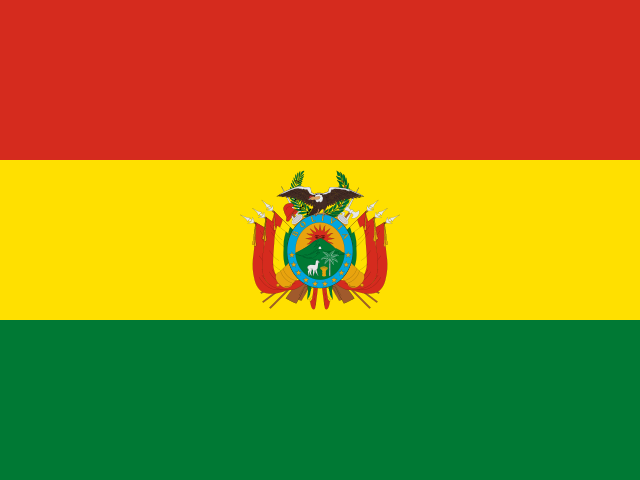 Bolivia