Used to describe someone who always brings bad news, has a negative attitude, or carries bad energy. It refers to a person whose negative predictions often come true, or someone who is considered a jinx who brings bad luck.
That guy is a pájaro de mal agüero. / I do not like that girl in the group, she is a pájaro de mal agüero.
A person who is clumsy or lacks skill in sports, most commonly used in soccer to describe someone who is stiff or immobile (often compared to being made of wood).
An expression used when there is both good news and bad news, or to describe a situation that has both positive and negative aspects. (The phrase refers to the mixture of lime and sand used to make mortar).
Una de cal y una de arena. I got promoted at work but I am going to have to be away from home for more hours.
Something chafa is crappy, of poor quality, or a letdown. Depending on the context, if a person is chafa, it means they are lame, they do things poorly, or they are boring.
That shirt is chafa, I prefer brand name ones. If you are chafa, the teacher is going to give us a bad grade. I do not like chafa cars, I prefer sports cars.
A versatile catch-all term used to express annoyance, boredom, or that something is a total drag or difficult. It is famously associated with the tukky subculture (a Venezuelan urban social group often linked to lower-class street style).
An expression used for someone who is useless, incompetent, or lacks talent in a task or sport, suggesting they are as stiff and clumsy as a plank. The variant de madera balsa (balsa wood) is also used to describe someone who is fragile or weak.
An extremely mean or inconsiderate person who takes advantage of others or behaves in a cruel way (In Venezuela, calling someone a rat is a standard way to label them a jerk or a scumbag).
Dude, que rata you are, don't you see this is a hospital and you shouldn't smoke! / Man, que rata, you went too far dude! How could you tie his shoes like that?
In soccer slang, used to describe a weak defense or a player who is easy to beat. It implies they are soft and crumble under pressure, much like the consistency of the custard dessert.
An adjective used with a noun, such as a business or a profession, to describe a person or place providing services illegally, without a license, or under the table.
He went to see a médico brujo. | That is a clínica bruja, do not go there.
Describes something that is very cool, impressive, or high-quality. (It suggests that something is so good it belongs on a promotional poster or main-event advertisement).
Those shoes estan cartel. That really is esta cartel, my brother.
A person who is a chronic liar or a bullshitter. It describes someone who is always telling tall tales or making up excuses. (In Venezuela, a roña is a lie or a story used to deceive someone).
I do not believe a word that guy says, because he has been a Roñoquero his whole life. Everyone you know is just a bunch of Roñoqueros.
A wicked or devious person from the region of Murcia. The idea is that feathers supposedly increase a person's level of malice, which is why parrots, viewed as rude and obnoxious creatures, have them (Murcia is a region in southeastern Spain).
You should not hang out with that guy, he is a demonio emplumao.
Something of poor quality, ugly, or sketchy. It refers to objects, situations, or people that are informal, improvised, or unreliable (In Venezuela, it often describes things done without professionalism or official standards).
That seems caiman to me. / I do not trust that caiman.
A hack, a phony, or an incompetent person who does shoddy work. It describes someone who lacks the necessary skills for their job or acts deceptively about their professional qualifications.
"Don't give me a pirata job", "I don't accept pirata people in my company"
A piece of junk, a clunker, or any object that is old, of poor quality, or in bad condition (literally a large metal pot, used colloquially to describe beat-up cars or broken appliances).
That perol does not work anymore. I am not buying that perol.
Refers to something or someone very cool, top-notch, or original. It is used to describe objects, events, or people that stand out for their quality or style (The term comes from having a cartel, which refers to someone's reputation or prestige).
That car is incredibly Cartelu'o; The party was Cartelu'a; That guy is so Cartelu'o.
Someone who is totally incompetent at doing a task, or something that is poorly or clumsily made. (In Argentina, the term originally refers to people from the rural interior, implying a rustic or unrefined quality).
I tried to braid my hair but it ended up looking really chuncano.
to be of very poor quality, a low-rent version, or a person who is a nasty piece of work (refers to off-brand products to imply something is bottom-of-the-barrel).
Referred to as the worst school in the city of Moca, it is characterized by physical violence, severe bullying, and indifferent teachers. Students often express a desperate desire to leave due to the toxic social environment, although the nuns in charge are sometimes noted as being kind. (Moca is a major city in the Espaillat province of the Dominican Republic).
At Colegio Maria Auxiliadora they even mess with your snack and the others just want to fight: when I brought chips like Doritos or Lays they told me it was forbidden, but I do not get it if parents are the ones who know what is best for their kids. A parent has the right to feed their child whatever they want, I think that is very wrong.
Adjective: A person who is mischievous or enjoys playing pranks and causing trouble. It describes someone who is always up to no good in a playful or annoying way.
A portmanteau of flaco (skinny) and triplehijueputa (an extreme, intensified version of son of a bitch). It is used to describe a person who is both very thin and incredibly malicious or evil.
Describes something of low quality, crappy, or shoddy.
I did not find what I was looking for at the dealership, the inventory only had models that were quite charcha. That tablet does not live up to expectations, for the price it is very charcha.
Used to describe someone or something that causes physical or emotional harm (this usage is the opposite of the word's standard dictionary meaning, which is harmless).


 Venezuela
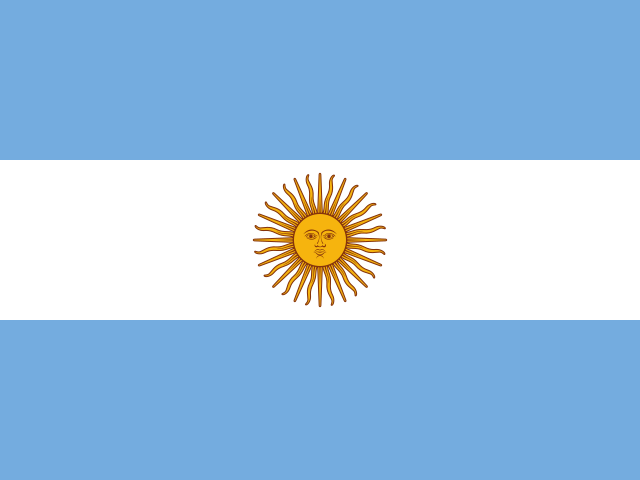 Argentina
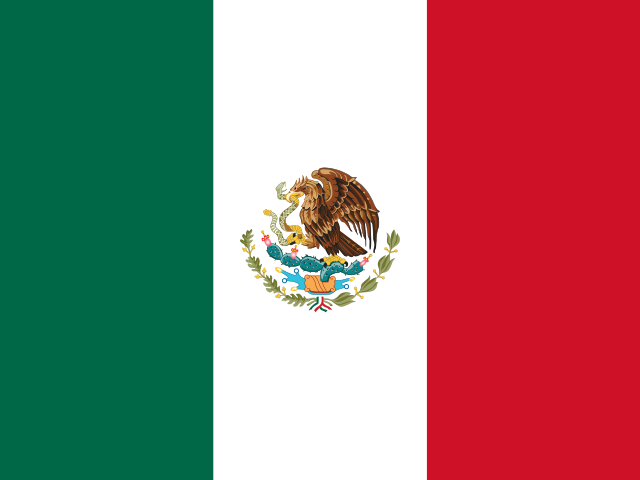 México
 Perú
Perú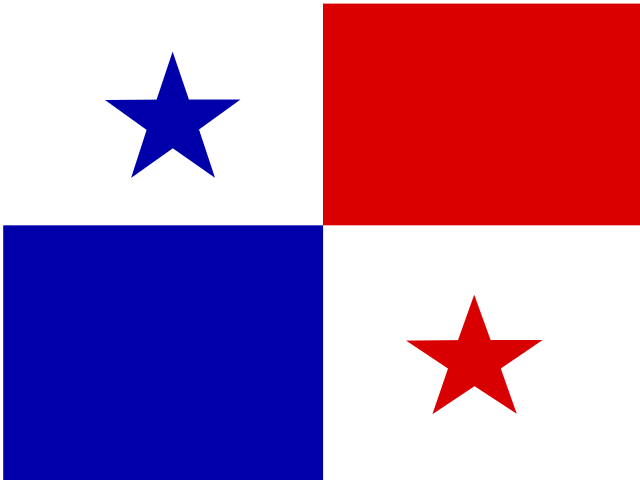 Panamá
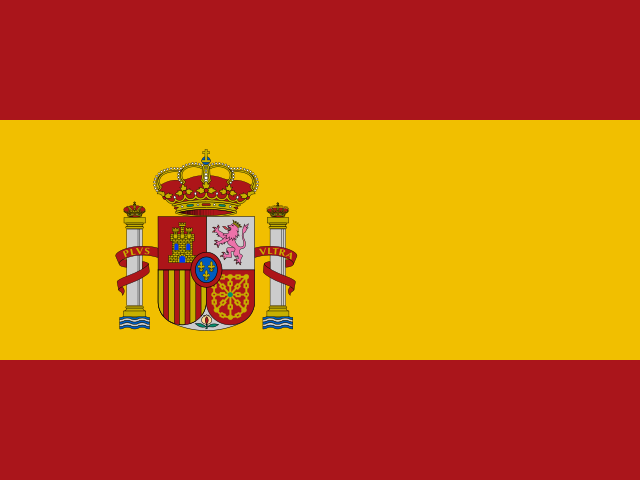 España
 Colombia
 República Dominicana
 Honduras
 Chile
Chile Ecuador