To wipe out or have a nasty accident, essentially beating the shit out of yourself. It refers to a violent fall or a close call with death (the word ñex is a Panamanian slang term used as a euphemism for mierda, meaning shit).
Man, I stepped on the mop and I had a sacada de ñex. I am never fucking mopping again in my life.
A very popular topical ointment used to soothe muscle pain (it is a specific brand of mentholated sports rub, similar to Icy Hot or Bengay, widely used in Panama).
A: 'I hurt my arm at the gym. It hurts so much!' B: 'Buy yourself a jar of Cofal and you will see how it clears up.'
An abscess or pocket of pus that forms at the edge of the fingers, typically resulting from an infection caused by contact with a poisonous plant or an insect bite.
This uñero hurts a lot, buddy. | Should I prick this uñero with a needle? Or will it hurt more?
An exclamation used to express frustration, annoyance, or sympathy, similar to saying what a bummer or what a mess. (In Venezuela, vaina is the most common all-purpose slang term for any object or situation, but this specific phrase is used to react to a negative occurrence).
Que vaina man, the truth is you do not want to change. / Que vaina friend, I am sorry you are feeling this way.
An expression used to justify taking a firm or drastic action to teach someone a lesson. It signals that one is asserting their worth or authority so the other person learns to show proper respect and stops taking them for granted.
Stop texting that guial, pa' que respete. Let her text you if she wants to talk (guial is a Panamanian term for a girl or young woman, derived from the English word). I am going to give you two hits with my flip-flop, pa' que respete.
A physical ailment, nagging pain, or discomfort that comes with a specific condition. It is most often used to refer to the minor health complaints associated with getting older or temporary physical cycles.
Those are just age-related achaques, that lady is very old now: Since she is on her period, she is acting like she has a ton of achaques weighing her down.
A deep sense of sadness, heartbreak, or nostalgia. It refers to a heavy, longing feeling caused by missing a person or a place. (In Panama, it is the standard term for being lovesick or homesick).
I am dying of cabanga | The cabanga won't even let him eat
A hit or punch so violent that it is presumed to be lethal.
If I catch you with that woman, you are not escaping the roncabalao I am going to give you. He told me if I did not apologize, he would give me a roncabalao.
An Asturian regionalism meaning to hurt or injure oneself. (Local lore suggests the term comes from ancient times when the Celtic people of the region only considered an injury painful if a limb was lost).
I manqué myself when I fell after tripping on that curb.
In Asturias, to get badly hurt or sustain a painful injury. (The word literally means to burn, but in this regional context it describes the sharp, stinging sensation of a hard impact or blow.)
I abrasé myself when I hit my shin against the table.
A sharp, localized muscle pain in the back or ribs. (It refers to the common folk belief that a cold draft or a sudden change in temperature can enter the body and cause a spasm).
I think I coji un aire: It must be that you cojiste un aire.
A vague feeling of physical malaise, body aches, or fatigue, often signaling the start of a cold or flu (in Dominican culture, it is a common catch-all term for feeling under the weather without a specific diagnosis).
A versatile exclamation used to express strong emotions like anger, disappointment, surprise, or joy (it is a common Colombian euphemism used to avoid more offensive vulgarities).
Hijuemadre! I won the lottery. Hijuemadre! This kid is really annoying!
The state of being totally out of it, drained, or overwhelmed by a physical sensation. It can be caused by exhaustion, annoyance, pain, or even a fit of uncontrollable laughter. It can also refer to feeling physically unwell as if a witch were hexing your body (referring to folk beliefs about witchcraft or the 'evil eye' causing sudden lethargy or sickness).
A state of breathlessness, temporary paralysis, or intense visceral pain caused by a hard blow to the solar plexus (referred to as the boca e letomago) or the ribs (referred to as abajo e lala).
And the guy left the woman priva with that heavy blow he gave her.
A phonetic variation of guebo (dick). While it literally refers to the penis, it is widely used as a versatile exclamation to express shock, surprise, admiration, or pain. (In the Dominican Republic, it functions as a general-purpose vulgar interjection similar to how damn or holy shit are used in English).
1: Bro, my grandma fell down the stairs and they had to hospitalize her. Holy webo man, do not tell me that. 2: Webo, that car is really fast! 3: Damn webo, I just smashed my finger with this damn hammer. 4: Look here, mamawebo.
A common folk ailment with vague symptoms, described as a pain or discomfort in a man's abdomen (often attributed to a displaced mass or knot in the belly in Dominican folk medicine).
My husband got a padrejón and I do not know where that pain came from.


 Panamá
 Bolivia
 Venezuela
 Argentina
 República Dominicana
 España
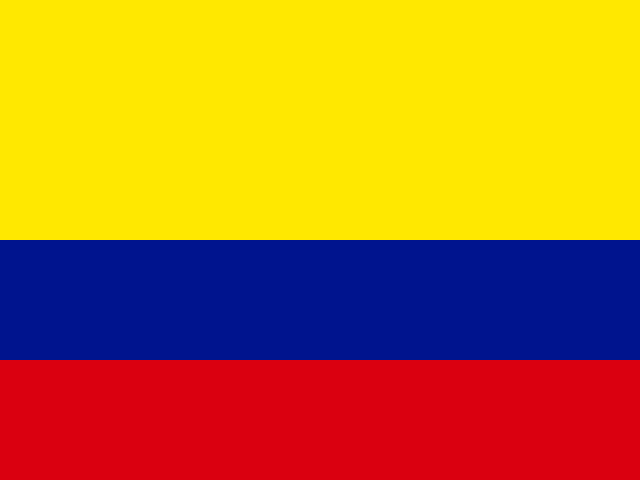 Colombia