Used to describe stolen or illegal goods sold at low prices on the black market. It refers to anything crooked or obtained through scams and shady deals.
They offered me a really cheap TV on the street, but I passed on it because it was definitely chueca.
Refers to the spin or rotation applied to a ball, especially in soccer, to make its trajectory curve or bend in the air. This technique is used to bypass obstacles like a defensive wall during a free kick.
He took advantage of the free kick and hit it with an impressive chanfle so the ball went right into the top corner.
Used for any package, bag, or backpack someone is carrying, especially if it is bulky or awkward. It also refers to an indistinct silhouette or blurry shape seen in the shadows or from a distance when you cannot tell exactly what it is.
I forgot the bulto of books in the classroom and now I have to go back for it.
An informal term for a stepson, referring to the son of one's spouse or partner from a previous relationship. While formal Spanish uses the word hijastro, this is the common street version used in Mexico.
I already told my entenado not to worry, I will pick him up at the bus station myself.
A very common term in Mexico for a person with dark or brown skin. Depending on the speaker's intent, it can be a neutral descriptor, an affectionate nickname, or a discriminatory slur.
My brother is the most prieto in the family because he actually likes being out in the sun all day.
A person who stirs the pot, creates drama, or agitates others, especially within political or workplace environments. It refers to someone who loves being in the middle of a mess and causing friction among colleagues or peers. (In Mexico, this usually describes someone constantly meddling in office or party politics to cause trouble).
Watch out for that guy because he is such a Grillo, he has already started spreading gossip to turn everyone against the coordinator.
Refers to things, animals, or food that are very dark or black. It is a common way to describe the intense color of certain ingredients or livestock. (In Mexico, this often refers to specific varieties of produce, such as the black sapote).
I only found sapote prieto at the market, so the dessert is going to be really sweet and dark.
Used to describe a shameless or brazen person who lacks remorse or worry regarding their own faults. It refers to someone who acts with excessive indifference or calmness in situations that should normally cause embarrassment or stress (in Mexico, the term relates to the idea of having a thick shell, or concha, that makes one immune to shame or social pressure).
My neighbor is so conchuda, she parked blocking my driveway and when I complained she just laughed and went into her house without moving the car.
Refers to any type of rope or cord used on boats for navigation or mooring maneuvers. It is the common and technical term used by sailors and fishermen to describe the various lines they handle at sea.
Let out a bit of cabo so the boat does not stay so tight with the movement of the waves.
A common slang term for a thief, crook, or petty criminal who steals others' belongings. It usually refers to street criminals or burglars who prowl the area looking for an easy target.
They say you have to be careful in that neighborhood because you always see cacos hanging around to see what they can steal from the houses.
A young worker in stables or ranches who cares for horses, including feeding, grooming, and preparing gear for riding. They are essential for animal welfare and stable organization.
We had to hire a new mozo because the last one could not keep up with cleaning the stalls and prepping the saddles for the bosses.
Used to express disbelief, skepticism, or shock when someone says something hard to believe. It is a quick way to challenge the truth of a statement because it sounds unlikely or exaggerated.
My brother says he saw a UFO on the hill last night. Ya! He was definitely dreaming.
Refers to a person's appearance or clothing, specifically when they look messy, disheveled, or way too casual for the occasion. It is used to describe someone who has not gotten ready or is wearing loungewear.
Don't take any pictures of me right now because I am in fachas and I haven't even combed my hair.
An informal way to say half of something, like a portion of food or an amount of money. It is typically used when proposing to split a cost or an object in two equal parts.
If you want, we can go micha on the rent so we have a bit more cash left over.
Used to describe someone who is motivated solely by money or material gain. It refers to a person who only associates with wealthy people to take advantage of them.
Stop inviting that guy to parties, he is a pamplemusa who only sticks to the ones with expensive bottles.
In Mexico, this refers to a heavy, coarse, and absorbent cloth used specifically for scrubbing or drying floors. It is a staple cleaning tool in most homes, typically wrapped around a squeegee or mop handle to wipe down tile or cement surfaces.
Be careful because I just used the jerga and the floor is still very wet.
Refers to the human capacity for reasoning, processing ideas, and storing memories. It is the internal space where the flow of consciousness and decision-making take place.
That guy has a very sharp Mente because he solves any problem in a second.
That moment at a party or dance when someone steps out alone to show off their best moves on the floor. It is basically taking the spotlight to prove your skills while everyone else watches. (In Mexican parties, it is common for the crowd to form a circle around someone doing a solo to cheer them on.)
Wait until the cumbión starts and I am going to drop a solo so they can see who owns the dance floor.
Used to refer to any person without specifying their identity, either because it is unknown or not important. It indicates that an unspecified subject is involved in an action without providing a specific name.
Can alguien lend me a lighter to light the charcoal stove (a traditional portable grill common in Mexico)?
The underlying intent behind an action, most commonly used in the phrase mala leche to mean acting out of spite or with a mean-spirited desire to cause trouble.
He did not hide it by accident, he did it out of pure mala leche.
A piece or length of rope, cord, or twine used to tie or secure something. In everyday Mexican Spanish, it refers to any scrap of rope or string used for fastening.
Look for a sturdy chicote so the load in the truck does not keep moving.
Used to describe an individual who is extremely clumsy or lacks mental sharpness. It is a common insult for calling someone stupid or lacking judgment in everyday situations.
Don't be such a cacorro and pay attention to the instructions, because of you we are going to have to start the whole job all over again.
It is a professional association or guild for people in the same career or trade. This group gathers specialists from a specific field to establish regulations and represent the interests of their profession (in this context, it refers to a regulatory board or professional body rather than a school).
My cousin already got his degree, but now he is looking into what is up with the requirements to join the colegio of civil engineers.
Used to describe someone who lacks street smarts or acts in a foolish, scatterbrained way. It refers to a person who is easily fooled or makes mistakes because they are naive.
Don't be a maje, did you really think they would sell you a car that cheap without there being a catch?
To park a vehicle in a spot. This is the standard colloquial term used instead of the formal Spanish word estacionarse (this usage is a loanword from the English verb to park).
If you want, just hop out here on the corner while I look for a place to parquear the truck.
A driver who operates a tank truck, known as a pipa, used to transport and deliver liquids like water or fuel. (In many parts of Mexico, residents rely on a pipero to refill home cisterns when the municipal water supply is cut off).
We already called the pipero to come refill the cistern because we do not have a single drop of water left in the house.
Refers to smuggled goods or contraband brought into the country illegally to evade customs and taxes. It is a common term for bootleg merchandise in border areas (the bridge mentioned in the example refers to the international border crossing between the US and Mexico).
Be very careful when crossing the bridge, because if they catch you with all that fufa in the trunk, you are going to be in a huge mess.
A vulgar term for the penis, typically used to emphasize its size or an erect state (literally, a macana is a heavy wooden club or a police truncheon).
That guy has such a big macana that you can see it through his jeans.
The cardinal direction where the sun sets. In everyday Mexican Spanish, people frequently use the term poniente to refer to this direction (it is common to see poniente used instead of oeste in street names and directions).
Go straight toward the oeste so you can make it in time to see the sunset at the beach.
A young woman from urban street subcultures, typically recognized by her baggy clothes and a tough or rebellious attitude. The term is associated with gang life and a distinct visual style involving heavy makeup (the subculture is rooted in the Mexican-American Chicano movement and emphasizes neighborhood loyalty).
Watch out for those cholas on the corner, because it looks like they are looking for a fight with anyone walking by.
A term for an extremely vain man who acts delicate, high-maintenance, or effeminate, regardless of his sexual orientation. It describes an egocentric, refined guy who expects to be the center of attention and avoids physical effort (the term is a masculine play on the word princess, mocking men who act too fragile for manual labor).
Stop acting like a princeso and help us carry these things, you are not going to break a nail by working a little.
A solid food made from curdled milk that has been separated from the whey. Its flavor varies significantly based on how it is produced and aged, ranging from panela to the popular string cheese (queso de hebra is a braided, meltable variety often called Oaxaca cheese).
I went to the market and bought a kilo of fresh Queso to make us some loaded quesadillas.
A vulgar slang term for a menstrual pad. The name comes from how the product sits between the legs, mimicking the straddled posture of someone riding a horse.
Wait for me a second while I go to the bathroom to change my caballo, because I feel like I need to.
A small piece of gauze or adhesive material used to cover a wound while it heals. It also refers to a scrap of cloth or leather sewn onto a garment to patch a hole or for decoration.
I have to buy some parches at the pharmacy because I got a blister on my heel from my new shoes.
A Mexican slang term for someone who is acting ditzy, naive, or absentminded. It is a synonym for dummy or airhead, often used in casual conversation between friends.
Oh, I looked so totona forgetting the keys inside the car again.
A specific case or real-life situation used to better explain an idea or prove a point. It is essentially a practical demonstration that helps someone understand a concept.
The teacher spent the whole time giving one ejemplo after another so we would understand well how the law of gravity works.
Used to describe factory facilities or building floors, and colloquially to refer to a permanent staff member with a stable, fixed position in a company.
My cousin is already de planta at the truck assembly plant, so he does not worry about his contract running out anymore.
Used to describe something that is crystal clear, spotless, or perfectly transparent. It applies to literal objects like glass or water, as well as ideas or speech that are direct and easy to understand.
I love swimming in this cenote because the water is so nítida you can see the fish all the way at the bottom. (A cenote is a natural water-filled sinkhole common in the Yucatan Peninsula).
A highly vulgar expression used in Mexico to tell someone to fuck off or to get rid of a situation that is causing total frustration. It is a heavy insult equivalent to telling someone to go to hell. (In Mexico, it refers to a symbolic, distant place of ruin or abandonment.)
I am fed up with your complaints, just go a la chingada and do not come looking for me anymore!
A reckless or aggressive driver who ignores traffic laws and endangers others. It describes someone with no driving etiquette who causes accidents and chaos (often used in Mexico to describe public transit drivers).
That minibus almost hit me because he was speeding, you can tell the driver is a cafre.
Describes something pointless, useless, or a waste of time that yields no benefit. It refers to situations or conversations that are unnecessary because they lead nowhere productive.
Stop dwelling on that Ocioso subject that doesn't even affect us anymore and focus on what really matters instead.
Refers to a person who is aggressive, annoying, or acts like a jerk for no reason. It also describes places or moments where there is a lot of tension and a fight seems about to break out (in Mexico, this is often used to describe a bad vibe at a party or club).
That club got really hostil when they started pushing people at the entrance, so we just split.


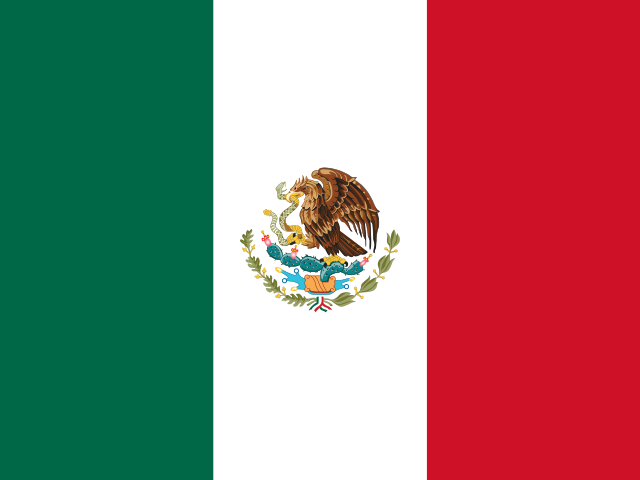 México