A casual and affectionate way to address a lifelong friend or close homie. It is common in urban slang to identify those in your inner circle (short for pariente, or relative, used to address friends as if they were family).
A busybody who sticks their nose into other people's business or butts into conversations that are not their concern. It refers to a person who is always hunting for gossip or offering unsolicited opinions.
Please don't tell the neighbor anything because she is a total metiche and soon the whole neighborhood will know (a colonia is a neighborhood).
Used to describe something that is extremely shiny or has a very polished surface. It is a slang way to say an object has a striking or eye-catching glow (a cocuyo is a type of bioluminescent beetle).
You left the floor so clean that it turned out real COCUYO, I am even afraid to step on it.
Refers to the paste or wax used to shine leather shoes, providing a protective coating and a glossy finish. In Mexico, this is the everyday term for shoe polish, whereas other Spanish-speaking countries might use the more formal word betún.
I bought a tin of neutral grasa so my new shoes would not lose their color.
Refers to an individual piece of sweet bread baked in a small mold, similar to a muffin or a small sponge cake. It is the colloquial way to refer to what is commonly known as a cupcake or muffin.
I went to the bakery and bought a chocolate queque to have for a snack with a glass of milk.
A woman who is shameless, brazen, or has a lot of nerve. It describes someone who acts with total cynicism and a lack of responsibility, often taking advantage of others' kindness without feeling guilt. (Derived from concha, meaning shell, implying the person has a thick skin against shame or criticism).
Look how conchuda your sister turned out: she spent all the rent money on clothes and now she wants us to pay the light bill for her.
A colloquial term for a stepchild. It refers to the son or daughter your current partner had from a previous relationship who is now part of your family. (In Mexico, this term is frequently used in everyday conversation instead of the more formal word hijastro).
My wife already had an entenado when we started dating, but we get along great and I love him like he is my own.
Used to describe someone who is extremely rude, arrogant, or behaves like a total jerk toward others. It refers to a despicable person who acts with malice or like a bully without caring who they hurt.
Watch out for the new boss because he turned out to be a TURRO who treats everyone like crap.
Fried skin or meat trimmings (usually pork, sometimes beef) rendered in their own fat until golden and crunchy. It is a staple ingredient in Mexican cuisine, eaten as a crispy snack or simmered in sauces for stews.
Let's go get some chicharron tacos with green salsa for lunch, my stomach is growling.
The part of a piece of clothing, like a t-shirt or a jacket, that covers or wraps around the arm. It can reach down to the hand or be cut shorter, depending on the type of garment you are wearing.
What is up with this heat! I am going to put on a short manga shirt instead so I am not walking around sweating so much in the street.
Refers to any candy or frozen dessert served on a small stick that acts as a handle. They are commonly made of hard candy or prepared with flavored ice and dairy (in Mexico, these are a street food staple often sold from pushcarts or shops called paleterias).
My little brother really wanted a mango with chili Paleta as soon as he saw the ice cream cart.
Used to describe someone who is very famous, high-profile, or a big deal in society. It refers to a person who is widely recognized for being important or highly distinguished in their profession.
That designer is super conocido in the fashion world, even celebrities fight over his dresses.
A pocket in a piece of clothing like pants, hoodies, or jackets. (In Mexico, this is the standard term for a clothing pocket, whereas in many other Spanish-speaking countries, a pocket is called a bolsillo and a bolsa refers to a bag or sack).
Check the bolsas of your jacket carefully because I am sure you kept the movie ticket in there.
A solid or semi-solid organic compound stored by living organisms as energy reserves. It is a substance that does not mix with water and is commonly used in cooking, cleaning products, and as a lubricant for machinery.
Trim the excess Grasa off the meat before putting it in the pan so it does not splatter so much.
Shoe polish or wax used to clean, protect, and shine leather footwear. It is the essential product used by boleros (traditional street shoe shiners) to make shoes look sharp.
Before heading to the party, put a little Grasa on your boots so they shine up well.
An extension of the spine that protrudes from the rear of various animals. It is the common term for the appendage that dogs wag when happy or that livestock use to swat insects.
Be very careful when walking behind the cow, she might give you a good smack with her Rabo if she gets spooked.
To shave the head completely using a razor or clippers at the lowest setting. It is what you do when you want to go totally bald and not have a single hair of a fool left (a play on the Spanish idiom for being sharp and not easily fooled).
They had to rapar my cousin because he got gum stuck on the crown of his head.
A white or gray hair. It refers to hair that loses its natural pigmentation due to age or genetics, serving as the most common physical sign of reaching maturity.
No way! I just found a Cañá in my beard even though I am barely thirty.
A simple sales slip or receipt listing purchases and prices, used to track expenses when a formal tax invoice is not needed. (In Mexico, a nota is an informal receipt, distinct from the official factura required for tax deductions).
Excuse me, boss, can you give me a nota for the bags of cement so they give me the money at the office?
A tool with bristles used to comb hair, brush teeth, or clean clothes and footwear. It also refers to a wood plane, a carpentry tool with a blade used to shave down wood to make it smooth.
Give that wood a pass with the Cepillo so the chairs do not give us splinters.
A curfew mandated by authorities during an emergency or social conflict. It also refers to the warning or signal indicating it is time to go indoors and rest.
Yesterday the soldiers passed by warning that the queda would be early because of the riots downtown.
A shady political operator or schemer who focuses on backroom deals and intrigue for personal gain. It describes someone who opportunistically manipulates people within political parties, unions, or the government to climb the ladder (the term literally means cricket, referring to the constant noise of political chatter and maneuvering).
That guy is the worst kind of Grillo, he just spends his time spreading rumors in the union to see what position he can get in the next elections.
A manipulative political schemer or agitator who stirs up trouble and discord. This person specializes in sabotaging initiatives or creating chaos through intrigue and backstabbing, usually within organizations, unions, or political circles.
Stop listening to that grillo, all he wants is to rile people up so the new union rules don't get approved.
The round, inflatable ball used for sports like soccer or volleyball. In Mexico, it is the essential item for starting a reta (a casual pickup game or challenge match, usually played in the street or on local courts).
The balón already popped from playing on the pavement so much, we are going to have to buy another one for the final.
It is the outer area of the female genitals, basically what can be seen at a glance, including the labia majora and minora. Many people use the word 'vagina' for everything, but this is the correct term for the external part that protects the vaginal canal.
In anatomy class they taught us that the vulva and the vagina are not the same, even though many people confuse them.
A Mexican slang term used to describe something intense, high-energy, or full of flavor. It characterizes a person, situation, or vibe as being exciting, bold, or spicy, often used when an event reaches its peak level of excitement.
That neighborhood party got really ajisoso once the sound system started playing (referring to the mobile sound systems used in Mexican street dances): everyone was full of energy.
Used to describe anything related to sex, including anatomy, the physical act, behavior, and education. (In Mexico, high school is commonly called prepa).
In high school they gave us a talk on sexual health to teach us how to use birth control correctly.
A term for a three-dimensional statue or full-body sculpture. It is primarily used for monuments and religious figures that have depth and volume, distinguishing them from flat paintings or wall reliefs.
Tourists are always taking photos in front of the bulto of Miguel Hidalgo (a hero of Mexican independence) in the city center.
A Mexican term for a restless and mischievous person, typically a child. It refers to someone who is a handful or a little rascal because they are always up to no good or full of energy (the word is often used as a euphemism for a little devil).
Watch out for my neighbor's son because he is a pingo and he will definitely hide your phone if you are not careful.
A slang term for a weak bladder or urinary incontinence, used to describe the constant urge to urinate or the inability to hold it. It is an informal way to talk about these physical issues in daily conversation.
My grandpa does not want to go to parties anymore because he gets the angurria and he is embarrassed about not making it to the bathroom in time.
A very popular term in Mexico used to express laziness, apathy, or a total lack of motivation. It is also used to describe a situation or thing that is extremely boring, tedious, or a drag.
It gives me such gueva having to go to the grocery store right now when it is so crowded!
An inflatable ring or inner tube used as a float in pools or the sea. It is the accessory commonly used by children or non-swimmers to stay above water without sinking. (In Mexico, this word literally means tire, referring to the shape of the float).
Hey, lend me your llanta to get in the ocean, the waves are really strong here and I am already tired of paddling!
A Mexican colloquial expression used to indicate that something is a joke, a fabrication, or a statement lacking seriousness. It is common in informal settings to reveal that a previous claim or bit of fake news was just for fun.
Don't get worked up, what I told you about your car being crashed was just wasa.
Refers to the messy office politics, backstabbing, and power plays common in political, professional, or union circles. It describes the toxic environment where people use rumors and manipulation to sabotage rivals or advance their own interests.
You should stay out of the union grilla if you do not want them making up rumors to get you fired.
A common Mexican exclamation used to say no emphatically or to express disbelief. It is a shortened version of no hombre and is used constantly in casual conversation.
You're asking if I'll lend him my car? nombre, not a chance!
An informal term used in certain regions to refer to a young woman or a romantic partner. It is a direct equivalent to the word chava and is commonly used to mean girlfriend. (In Mexico, this specific variation is regional compared to the more universal chavo).
I saw Beto yesterday walking through downtown looking all lovey-dovey with his chama.
An interjection used in Mexico to express shock or great surprise at something unexpected. It is a shortening of the word burro (donkey) and serves as a spontaneous reaction of disbelief.
Urro! I didn't expect the dinner bill to be so expensive.
A Mexican slang term for extreme laziness or a total lack of motivation to fulfill an obligation. It describes a deep lethargy where any activity feels like a chore and you just want to lounge around. (It is the phonetic spelling of hueva, which literally means fish roe but is used colloquially to imply sluggishness).
I feel such a weba having to clean the whole kitchen today, let's just order a pizza and lie down to watch TV.
A thick and sturdy cotton fabric that features a distinct texture of raised vertical ribs. Its weight makes it ideal for warm winter clothing like trousers or blazers.
Pass me my pana jacket because it already started to get cold out here.
Refers to various styles of cooking or culinary traditions categorized by their region of origin or specific ingredients, such as regional specialties or plant-based options.
My aunt always prepares a lot of comida from Puebla when we visit her because she knows we love the chiles en nogada (stuffed peppers in walnut sauce, a specialty of the state of Puebla).
A mild Mexican exclamation used as a polite substitute for harsher words starting with ch, such as chingar. It signals regret, disappointment, or the realization that something went wrong, similar to saying darn or shoot.
Chin! I forgot to pick up the tortillas and the store is already closed.


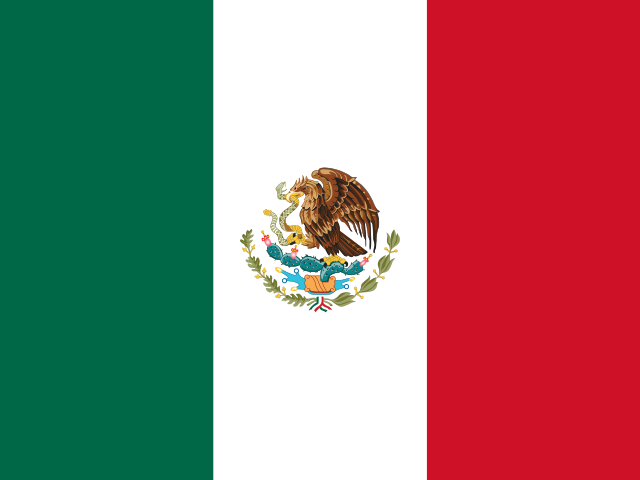 México